

T3-V-PRO Module Datasheet
T3-V-PRO is a voice module developed by Tuya Smart. It consists of a highly integrated radio frequency chip, T3, and a Chipintelli CI1302 voice chip, supporting combo Wi-Fi and Bluetooth Low Energy (LE) protocols.
Overview
T3-V-PRO is a Wi-Fi AI module that supports offline and online voice control. It integrates the Tuya AI platform, enables interaction through voice, and connects to major AI platforms via the Tuya AI Agent. It supports large language models such as Doubao, DeepSeek, Qwen, OpenAI, and Gemini. It features button wake-up, wake-word activation, and free talk capabilities, providing users with a vivid and engaging AI voice interaction experience. It is suitable for smart products in voice interaction scenarios.
T3-V-PRO has a built-in 32-bit MCU with a maximum operating speed of 320 MHz, 4 MB flash memory, and 640 KB SRAM.
Features
- Built-in low-power 32-bit CPU that also acts as an application processor.
- Clock rate of 320 MHz.
- Operating voltage range: 3.6V to 5.5V.
- Peripherals: 5×PWM, 1×SDIO, 1×UART, and 1×SPI.
- Wi-Fi connectivity
- IEEE 802.11b/g/n/ax.
- Channels 1 to 14 at 2.4 GHz (CH1-11 for US/CA, CH1-13 for EU/CN).
- Support WPA2, WPA2 PSK (AES), and WPA3 security modes.
- The maximum output power is +17 dBm for IEEE 802.11b transmission.
- Two pairing modes are supported, namely Bluetooth and AP mode. Both modes are suitable for pairing with Android and iOS mobile phones.
- The onboard PCB antenna has a peak gain of 1.72 dBi.
- Operating temperature range: -40°C to +85°C.
- Bluetooth connectivity
- Bluetooth Core Specification v5.4.
- The transmitter power in Bluetooth mode is 6 dBm.
Scope of applications
- AI-powered digital entertainment products
- Smart home and electrical appliance
- Smart socket and light
Module interfaces
Dimensions and footprint
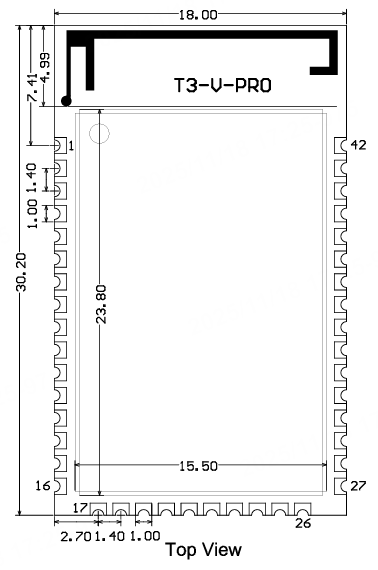
The T3-V-PRO dimensions are 18±0.35 mm (W) × 30.2±0.35 mm (L) × 3.0±0.15 mm (H). The figure below shows the dimensions of the T3-V-PRO module.
Pinout
| Pin No. | Symbol | I/O type | Description |
|---|---|---|---|
| 1 | GND | P | Ground pin. |
| 2 | P25 | I/O | Standard GPIO pin, which can be reused as an ADC pin. |
| 3 | RST | I | Reset pin. |
| 4 | TX1 | I/O | Logging port, corresponding to P0 on T3. |
| 5 | RX1 | I/O | Logging port, corresponding to P1 on T3. |
| 6 | P28 | I/O | Standard GPIO pin, which can be reused as an ADC pin. |
| 7 | TX0 | I/O | T3 firmware flashing port, corresponding to P11 on T3. |
| 8 | RX0 | I/O | T3 firmware flashing port, corresponding to P10 on T3. |
| 9 | P48 | I/O | Standard GPIO pin. |
| 10 | CI_TX0 | I/O | Firmware flashing port TX0 of the audio chip. |
| 11 | CI_RX0 | I/O | Firmware flashing port RX0 of the audio chip. |
| 12 | P32 | I/O | Standard GPIO pin, which can be reused as a PWM pin. |
| 13 | CI_PWR | P | The power control enable pin of the voice chip, active high, corresponding to P12 on T3. |
| 14 | NC | - | NC. |
| 15 | VBAT | P | Power pin. |
| 16 | NC | - | NC. |
| 17 | NC | - | NC. |
| 18 | NC | - | NC. |
| 19 | AGND | P | Analog ground pin. |
| 20 | MIC- | AI | Negative input of microphone. |
| 21 | MIC+ | AI | Positive input of microphone. |
| 22 | NC | - | NC. |
| 23 | NC | - | NC. |
| 24 | SPK+ | AO | Positive output of audio. |
| 25 | SPK- | AO | Negative output of audio. |
| 26 | GND | P | Ground pin. |
| 27 | NC | - | NC. |
| 28 | NC | - | NC. |
| 29 | NC | - | NC. |
| 30 | P19 | I/O | Standard GPIO pin. |
| 31 | PA4 | I/O | For debugging purposes only. Not for customer use. |
| 32 | NC | - | NC. |
| 33 | P15 | I/O | Standard GPIO pin, which can be reused as SPI_CS. |
| 34 | P17 | I/O | Standard GPIO pin, which can be reused as SPI_MISO. |
| 35 | P14 | I/O | Standard GPIO pin, which can be reused as SPI_SCK. |
| 36 | P16 | I/O | Standard GPIO pin, which can be reused as SPI_MOSI. |
| 37 | P34 | I/O | Standard GPIO pin, which can be reused as a PWM pin. |
| 38 | MUTE | O | The enable pin for the built-in audio power amplifier. Not for customer use. |
| 39 | P36 | I/O | Standard GPIO pin, which can be reused as a PWM pin. |
| 40 | P24 | I/O | Standard GPIO pin, which can be reused as a PWM pin. |
| 41 | P18 | I/O | Standard GPIO pin, which can be reused as a PWM pin. |
| 42 | GND | P | Ground pin. |
- The maximum input level of the ADC port is 3.25V. It is recommended to use MΩ-level external voltage divider resistors and place a 100 nF ground filter capacitor close to the ADC port.
Pindicates the power pin,I/Oindicates the input and output pin,AIindicates the analog input signal, andAOindicates the analog output signal.
Electrical parameters
Absolute electrical parameters
| Parameter | Description | Minimum value | Maximum value | Unit |
|---|---|---|---|---|
| Ts | Storage temperature | -55 | 125 | °C |
| VBAT | Supply voltage | - | - | V |
| Electrostatic discharge voltage (human body model) | TAMB -25°C | -4 | 4 | kV |
| Electrostatic discharge voltage (machine model) | TAMB -25°C | -200 | 200 | V |
Normal operating conditions
| Parameter | Description | Minimum value | Typical value | Maximum value | Unit |
|---|---|---|---|---|---|
| Ta | Operating temperature | -40 | - | 85 | °C |
| VBAT | Supply voltage | 3.6 | 5 | 5.5 | V |
| VOL | I/O low-level output | 0 | - | 0.3 | V |
| VOH | I/O high-level output | 3.0 | - | 3.3 | V |
| Imax | I/O drive current | - | 6 | 20 | mA |
Radio frequency (RF) power
| Operating status | Mode | Rate | Transmit/Receive power | Platform current | Peak (Typical) value | Unit |
|---|---|---|---|---|---|---|
| Transmit | 11 b | 11 Mbit/s | +17 dBm | 140 | 275 | mA |
| Transmit | 11 g | 54 Mbit/s | +15 dBm | 132 | 242 | mA |
| Transmit | 11 n | HT20 MCS7 | +14 dBm | 128 | 244 | mA |
| Transmit | 11 ax | HE20 MCS7 | +14 dBm | 120 | 224 | mA |
| Receive | 11 b | 11 Mbit/s | Continuous reception | 17 | 60 | mA |
| Receive | 11 g | 54 Mbit/s | Continuous reception | 17 | 60 | mA |
| Receive | 11 n | HT20 MCS7 | Continuous reception | 17 | 60 | mA |
| Receive | 11 ax | HE20 MCS7 | Continuous reception | 17 | 60 | mA |
Operating current
| Operating mode | Status (Ta = 25°C) | Average value | Max (Typical) value | Unit |
|---|---|---|---|---|
| Pairing over Bluetooth | The module is pairing over Bluetooth. The network status indicator blinks slowly. | 90 | 280 | mA |
| Pairing over AP | The module is pairing in AP mode. The network status indicator blinks slowly. | 95 | 290 | mA |
| Connected | The module is connected to the cloud. The network status indicator is steady on. | 70 | 270 | mA |
| Weakly connected | The connection between the module and the access point is intermittent. The network status indicator is steady on. | 100 | 295 | mA |
| Disconnected | The module is disconnected from the cloud. The network status indicator is steady off. | 70 | 290 | mA |
RF parameters
Basic RF features
| Parameter | Description |
|---|---|
| Operating frequency | 2.402 to 2.4835 GHz |
| Wi-Fi standard | IEEE 802.11b/g/n/ax (channels 1–14) |
| Data transmission rate |
|
| Antenna type | PCB antenna |
Wi-Fi transmitter (TX) performance
| Parameter | Minimum value | Typical value | Maximum value | Unit |
|---|---|---|---|---|
| RF average output power, 802.11b CCK mode, 11 Mbit/s | - | 17 | - | dBm |
| RF average output power, 802.11g OFDM mode, 54 Mbit/s | - | 15 | - | dBm |
| RF average output power, 802.11n OFDM mode, MCS7 (HT20) | - | 14 | - | dBm |
| Frequency error | -20 | - | 20 | ppm |
Wi-Fi receiver (RX) performance
| Parameter | Minimum value | Typical value | Maximum value | Unit |
|---|---|---|---|---|
| PER < 8%, RX sensitivity, 802.11b DSSS mode, 11 Mbit/s | - | -88 | - | dBm |
| PER < 10%, RX sensitivity, 802.11g OFDM mode, 54 Mbit/s | - | -75 | - | dBm |
| PER < 10%, RX sensitivity, 802.11n OFDM mode, MCS7 (HT20) | - | -73 | - | dBm |
| PER < 10%, RX sensitivity, Bluetooth LE, 1 Mbit/s | - | -96 | - | dBm |
Bluetooth TX performance
| Parameter | Minimum value | Typical value | Maximum value | Unit |
|---|---|---|---|---|
| Operating frequency | 2.402 | - | 2.4835 | GHz |
| Transmission rate over the air | - | 1 | - | Mbit/s |
| Transmission power | - | 6 | - | dBm |
| Frequency error | -150 | - | 150 | kHz |
Bluetooth RX performance
| Parameter | Minimum value | Typical value | Maximum value | Unit |
|---|---|---|---|---|
| RX sensitivity | - | -96 | - | dBm |
| Max RF signal input | -10 | - | - | dBm |
| Intermodulation | - | - | -23 | dBm |
| Co-channel rejection ratio | - | 10 | - | dB |
Antenna information
Antenna type
The T3-V-PRO module uses an onboard PCB antenna.
Antenna interference reduction
When a PCB antenna is used on a Wi-Fi module, we recommend that the module antenna is at least 15 mm away from other metal components. This can optimize the Wi-Fi performance.
Make sure that the enclosure surrounding the antenna is not traced or filled with copper. Otherwise, the RF performance might be degraded.
Footprint and production instructions
Mechanical dimensions
Dimensions of the T3-V-PRO PCB are 18±0.35 mm (W) × 30.2±0.35 mm (L) × 0.8±0.1 mm (H).
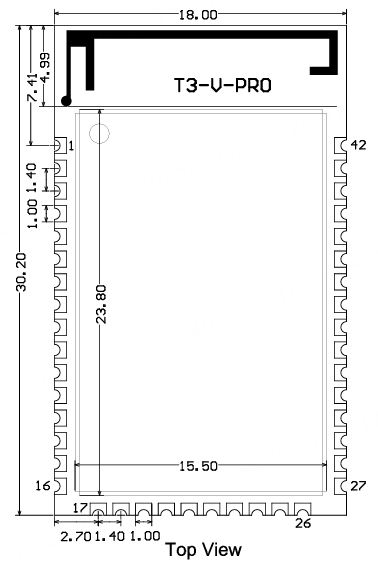
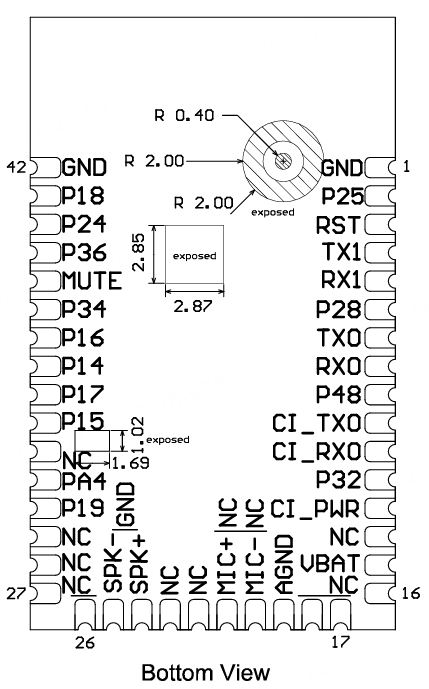
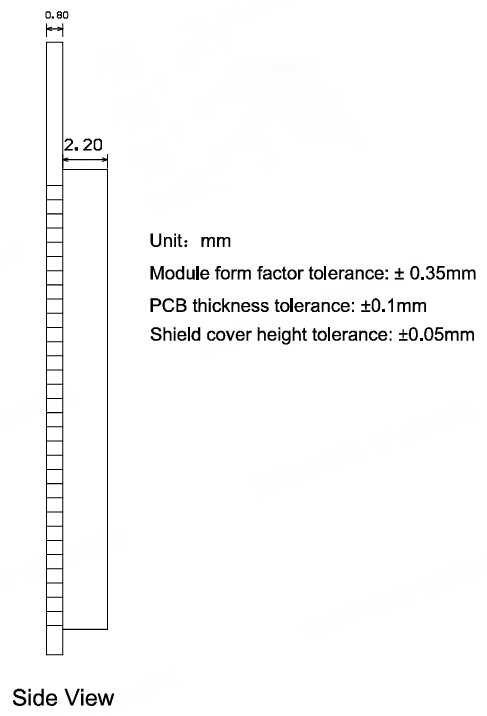
The figure below shows the recommended footprint of the T3-V-PRO module.
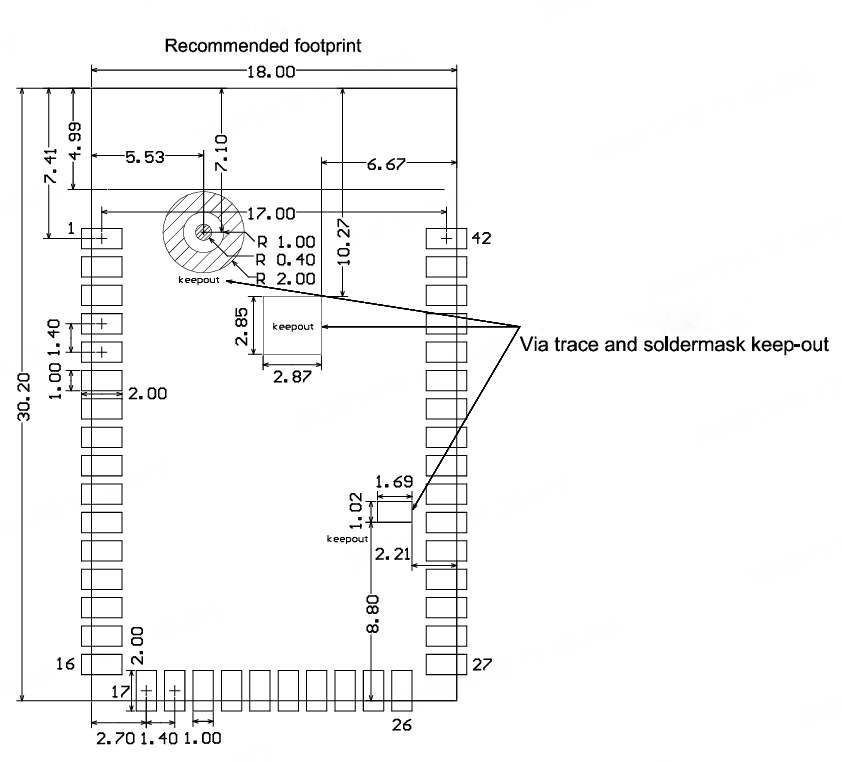
The area indicated as keep-out in the diagram above does not require tinning and should not have any traces routed through it.
Production instructions
-
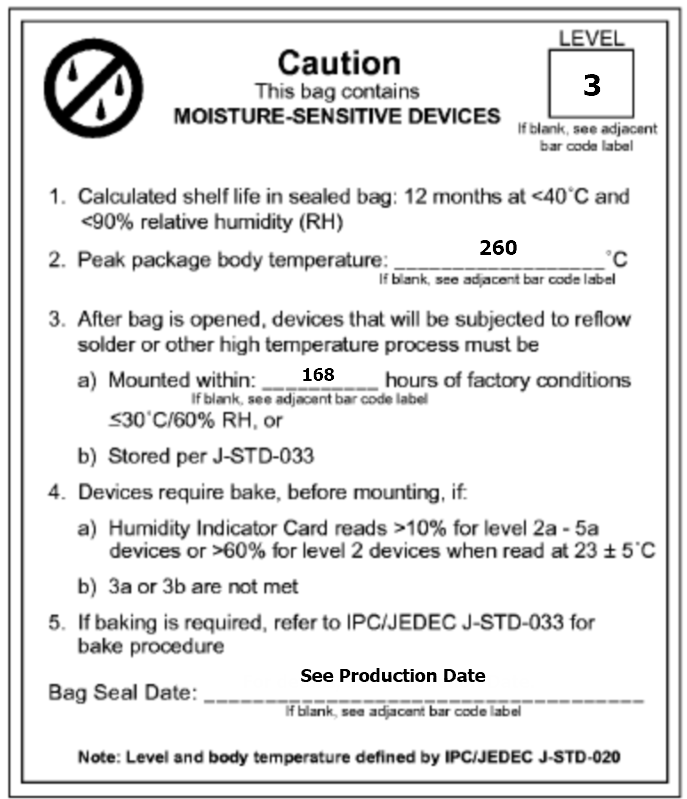
Package the module with the SMT if Tuya’s module is designed to be SMT-packaged. After being unpacked, the module must be soldered within 24 hours. Otherwise, it needs to be put into a drying cupboard with a relative humidity level no greater than 10%, or packaged in vacuum again. Then, record the packing time and duration of exposure. The total exposure time cannot exceed 168 hours.
- Instruments or devices required for the SMT process:
- Surface mount system
- SPI
- Reflow soldering machine
- Thermal profiler
- Automated optical inspection (AOI) equipment
- Instruments or devices required for the baking process:
- Cabinet oven
- Electrostatic discharge (ESD) protection and heat-resistant trays
- ESD protection and heat-resistant gloves
- Instruments or devices required for the SMT process:
-
A delivered module must meet the following storage requirements:
-
The moisture-proof bag must be placed in an environment where the temperature is below 40°C and the relative humidity is lower than 90%.
-
The shelf life of a dry-packaged product is 12 months from the date when the product is packaged and sealed.
-
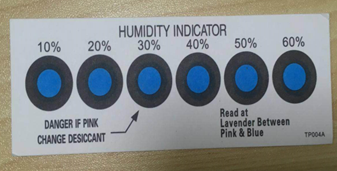
A humidity indication card (HIC) is put in the sealed package.
-
-
The module needs to be baked in the following cases:
- The vacuum packaging bag is damaged before unpacking.
- After unpacking, no HIC is found in the packaging bag.
- After unpacking, the HIC indicates a humidity level of 10% or higher. In this case, the circle turns pink on the HIC.
- The total exposure time has lasted for over 168 hours since unpacking.
- More than 12 months have passed since the first sealing of the bag.
-
The baking parameter settings are described below:
- Baking temperature: 40°C for reel packaging with relative humidity ≤ 5%. And 125°C for tray packaging with relative humidity ≤ 5% (use the heat-resistant tray, rather than plastic containers).
- Baking time: 168 hours for reel packaging and 12 hours for tray packaging.
- Temperature for triggering an alert: 50°C for reel packaging and 135°C for tray packaging.
- Production can begin after a module has cooled down to below 36°C under natural conditions.
- If a module remains unused for over 168 hours after being baked, it needs to be baked again.
- If a batch of modules is not baked after exposure for more than 168 hours, do not use reflow soldering to solder them. Because these modules are level-3 moisture-sensitive devices, they are very likely to get damp when exposed beyond the allowable time. In this case, if they are soldered at high temperatures, device failure or poor soldering performance might occur.
-
In the whole production process, take electrostatic discharge (ESD) protective measures.
-
To guarantee the pass rate, we recommend that you use the SPI and AOI to monitor the quality of solder paste printing and mounting.
Recommended oven temperature curve
Set the temperature according to the following temperature curve of reflow soldering. The peak temperature is 245°C.
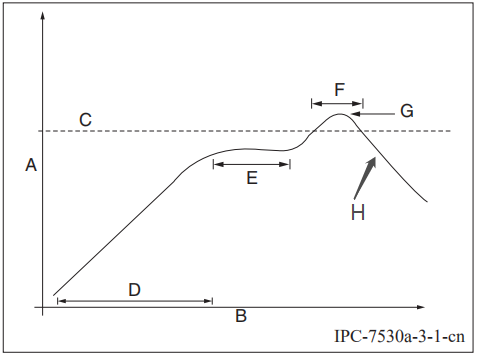
- A: temperature axis
- B: time axis
- C: alloy liquidus temperature from 217°C to 220°C
- D: ramp-up slope from 1°C/s to 3°C/s
- E: keep a constant temperature from 150°C to 200°C for a time period from 60s to 120s
- F: keep a temperature above liquidus temperature for 50s to 70s
- G: peak temperature from 235°C to 245°C
- H: ramp-down slope from 1°C/s to 4°C/s
The curve above is based on solder paste SAC305. For more information about other solder pastes, see the recommended oven temperature curve in the specified solder paste specifications.
Storage conditions
MOQ and packaging information
| Product model | MOQ (pcs) | Shipping packaging | Modules per reel | Reels per carton |
|---|---|---|---|---|
| T3-V-PRO | 4,400 | Tape and reel | 1,100 | 4 |
Appendix: Statement
This equipment has been tested and found to comply with the limits for a Class B digital device, pursuant to part 15 of the FCC Rules. These limits are designed to provide reasonable protection against harmful interference in a residential installation. This equipment generates, uses, and can radiate radio frequency energy and, if not installed and used in accordance with the instructions, may cause harmful interference to radio communications. However, there is no guarantee that interference will not occur in a particular installation. If this equipment does cause harmful interference to radio or television reception, which can be determined by turning the equipment off and on, the user is encouraged to try to correct the interference by one or more of the following measures:
— Reorient or relocate the receiving antenna.
— Increase the separation between the equipment and receiver.
— Connect the equipment into an outlet on a circuit different from that to which the receiver is
connected.
— Consult the dealer or an experienced radio/TV technician for help.
FCC Caution: Any changes or modifications not expressly approved by the party responsible for compliance could void the user’s authority to operate this device.
This device complies with Part 15 of the FCC Rules. Operation is subject to the following two conditions: (1) This device may not cause harmful interference, and (2) this device must accept any interference received, including interference that may cause undesired operation.
2.2 List of applicable FCC rules
This module has been tested and found to comply with Part 15C, Section 15.247 requirements for Modular Approval.
2.3 Specific Operational Use Conditions- Antenna Placement Within the Host Platform
The module is tested for standalone mobile RF exposure use condition.
- The antenna must be installed such that 20cm is maintained between the antenna and users,
- The transmitter module may not be co-ocated with any other transmitter or antenna.
In the event that these conditions can‘t be met (for example Certain laptop configurations or co-location with another transmitter), then the FCC authorization is no longer considered valid and the FCC ID can't be used on the final product. In these circumstances, the integrator will be responsible for reevaluating the end product (including the transmitter) and obtaining a separate FCC authorization.
2.4 Limited Module Procedures
Not applicable
2.5 Trace Antenna Designs
Not applicable
2.6 RF Exposure Considerations
This device complies with fcc radiation exposure limits set forth for an uncontrolled environment. This equipment should be installed and operated with minimum distance 20cm between the radiator & your body.
2.7 Antenna Type and Gain
The following antennas have been certified for use with this module. Only antennas of the same type with equal or lower gain may also be used with this module. Other types of antennas and/or higher gain antennas may require the additional authorization for operation.
Antenna Specification list below:
| Antenna Type | Antenna Model No. | Maximum Antenna Gain (dBi) | Frequency Range |
|---|---|---|---|
| PCB Antenna | T3-V-PRO Antenna | 1.72 dBi | 2402~2480 MHz |
2.8 End Product Labeling:
This transmitter module is authorized only for use in device. The final end product must be labeled in a visible area with the following: "Contains Transmitter Module FCC ID: 2ANDL-T3VPRO" Or "Contains FCC ID: 2ANDL-T3VPRO". The grantee's FCC ID can be used only when all FCC compliance requirements are met. The end product shall bear the following 15.19 statement: This device complies with part 15 of the FCC Rules. Operation is subject to the following two conditions:
(1) This device may not cause harmful interference, and
(2) This device must accept any interference received, including interference that may cause undesired operation.
2.9 Information on Test Modes and Additional Testing Requirements
The module is tested for standalone mobile RF exposure use condition. Any other usage conditions such as co-location with other transmitter(s) or being used in a portable condition will need a separate reassessment through a class Il permissive change application or new certification.
Host manufacturer installed this modular with single modular approval should perform the test of radiated emission and spurious emission according to FCC part 15C, 15.209, 15.207 requirement, only if the test result comply with FCC part 15C 15.209,15.207 requirement, then the host can be sold legally.
2.10 Additional testing, Part 15 Subpart B Disclaimer
This transmitter modular us tested as a subsystem and its certification does not cover the FCC Part 15 Subpart B rules requirement applicable to the final host. The final host will still need to be reassessed for compliance to this portion of rules requirements if applicable.
As long as all conditions above are met, further transmitter test will not be required. However, the OEM integrator is still responsible for testing their end-product for any additional compliance requirements required with this modular installed.
2.11 Manual Information to the End User:
The OEM integrator has to be aware not to provide information to the end user regarding how to install or remove this RF module in the User Manual of the end product which integrates this module. The end user manual shall include all required regulatory information/warning as show in this manual.
The host integrator must follow the integration instructions provided in this document and ensure that the composite-system end product complies with the requirements by a technical assessment or evaluation to the rules and to KDB Publication 996369.
The host integrator installing this module into their product must ensure that the final composite product complies with the requirements by a technical assessment or evaluation to the rules, including the transmitter operation and should refer to guidance in KDB 996369.
OEM/Host Manufacturer Responsibilities:
Manufacturers are ultimately responsible for the compliance of the Host and Module. The final product must be reassessed against all the essential requirements of the FCC rule such as FCC Part 15 Subpart B before it can be placed on the US market. This includes reassessing the transmitter module for compliance with the Radio and EMF essential requirements of the FCC rules. The module must not be incorporated into any other device or system without retesting for compliance as multi-radio and combined equipment.
2.12 How to Mike Changes-Important Note:
In the event that these conditions can‘t be met (for example Certain laptop configurations or co-location with another transmitter), then the FCC authorization is no longer considered valid and the FCC ID can't be used on the final product. In these circumstances, the integrator will be responsible for reevaluating the end product (including the transmitter) and obtaining a separate FCC authorization.
Declaration of Conformity European Notice

Hereby, Hangzhou Tuya Information Technology Co., Ltd declares that this module product is in compliance with essential requirements and other relevant provisions of Directive 2014/53/EU,2011/65/EU. A copy of the Declaration of conformity can be found at https://www.tuya.com.

This product must not be disposed of as normal household waste, in accordance with the EU directive for waste electrical and electronic equipment (WEEE-2012/19/EU). Instead, it should be disposed of by returning it to the point of sale, or to a municipal recycling collection point.
The device could be used with a separation distance of 20cm to the human body.
ISED Statement
This device complies with Innovation, Science and Economic Development Canada's licence-exempt RSSs. Operation is subject to the following two conditions:
(1) This device may not cause interference.
(2) This device must accept any interference, including interference that may cause undesired operation of the device.
Le présent appareil est conforme aux CNR d’Innovation, Sciences et Développement économique Canada applicables aux appareils radio exempts de licence. L’exploitation est autorisée aux deux conditions suivantes:
(1) l’appareil ne doit pas produire de brouillage.
(2) l’utilisateur de l’appareil doit accepter tout brouillage radioélectrique sub i, même si le brouillage est susceptible d’en compromettre le fonctionnement.
Radiation Exposure Statement
This equipment complies with IC radiation exposure limits set forth for an uncontrolled environment. This equipment should be installed and operated with minimum distance 20 cm between the radiator & your body.
Déclaration d’exposition aux radiations:
Cet équipement est conforme aux limites d’exposition aux rayonnements ISED établies pour un environnement non contrôlé. Cet équipement doit être installé et utilisé avec un minimum de 20 cm de distance entre la source de rayonnement et votre corps.
L’appareil peut interrompre automatiquement la transmission en cas d’absence d’informations à transmettre ou de panne opé rationnelle. Notez que ceci n’est pas destiné à interdire la transmission d’informations de contrôle ou de signalisation ou l’utilisation de codes répétitifs lorsque cela est requis par la technologie.
This device is intended only for OEM integrators under the following conditions:
(1) The antenna must be installed such that 20 cm is maintained between the antenna and users.
(2) The transmitter module may not be co-located with any other transmitter or antenna. As long as 2 conditions above are met, further transmitter test will not be required.
However, the OEM integrator is still responsible for testing their end-product for any additional compliance requirements required with this module installed.
Cet appareil est conçu uniquement pour les intégrateurs OEM dans les conditions
suivantes: (Pour utilisation de dispositif module)
(1) L’antenne doit être installée de telle sorte qu’une distance de 20 cm est respectée entre l’antenne et les utilisateurs.
(2) Le module émetteur peut ne pas être coïmplanté avec un autre é metteur ou antenne.
Tant que les 2 conditions ci-dessus sont remplies, des essais supplé mentaires sur l’émetteur neseront pas nécessaires. Toutefois, l’intégrateur OEM est toujours responsable des essais sur son produit final pour toutes exigences de conformité supplémentaires requis pour ce module installé.
IMPORTANT NOTE:
In the event that these conditions can not be met (for example certain laptop configurations or colocation with another transmitter), then the Canada authorization is no longer considered valid and the IC ID can not be used on the final product. In these circumstances, the OEM integrator will be responsible for re-evaluating the end product (including the transmitter) and obtaining a separate Canada authorization.
NOTE IMPORTANTE:
Dans le cas où ces conditions ne peuvent être satisfaites (par exemple pour certaines configurations d’ordinateur mobile ou de certaines co-localisation avec un autre émetteur), l’autorisation du Canada n’est plus considéré comme valide et l’ID IC ne peut pas être utilisé sur le produit final. Dans ces circonstances, l’intégrateur OEM sera chargé de réévaluer le produit final (y compris l’émetteur) et l’obtention d’une autorisation distincte au Canada.
End Product Labeling
This transmitter module is authorized only for use in device where the antenna may be installed such that 20 cm may be maintained between the antenna and users. The final end product must be labeled in a visible area with the following: "Contains IC:23243-T3VPRO" .
Plaque signalétique du produit final
Ce module émetteur est autorisé uniquement pour une utilisation dans un dispositif où l’antenne peut être installée de telle sorte qu’une distance de 20cm peut être maintenue entre l’antenne et les utilisateurs. Le produit final doit être étiqueté dans un endroit visible avec l’inscription suivante: "Contient des IC:23243-T3VPRO".
Manual Information To the End User
The OEM integrator has to be aware not to provide information to the end user regarding how to install or remove this RF module in the user’s manual of the end product which integrates this module.
The end user manual shall include all required regulatory information/warning as show in this manual.
Manuel d’information à l’utilisateur final
L’intégrateur OEM doit être conscient de ne pas fournir des informations à l’utilisateur final quant à la façon d’installer ou de supprimer ce module RF dans le manuel de l’utilisateur du produit final qui intègre ce module.
Le manuel de l’utilisateur final doit inclure toutes les informations réglementaires requises et avertissements comme indiqué dans ce manuel.
Is this page helpful?
YesFeedbackIs this page helpful?
YesFeedback