

Temperature and Humidity Sensor
Temperature and humidity are the basic factors for the comfort of homes and offices. They serve as the highly valued metrics collected in a wide range of business scenarios such as smart city, smart industry, smart agriculture, and shipment.
Product introduction
The temperature and humidity sensor uses an integrated chip to detect ambient temperature and humidity at scheduled intervals. Users can check the temperature and humidity data anytime and anywhere through the app.
Solution introduction
Tuya provides the no-code development solution for you to quickly start development and mass production of smart temperature and humidity sensors. For more information, see Solution Center > Temperature and Humidity Sensor Solutions.
Supported protocols
The no-code development solution supports the following protocols for screen-free products:
- Wi-Fi and Bluetooth Low Energy (Bluetooth LE)
- Bluetooth LE
- Zigbee
- Bluetooth mesh
- NB-IoT
Solution details
Core features
-
Networking capability: View device data in the app after pairing.
-
Temperature detection: Regularly detect temperature and show real-time data in the app.
-
Humidity detection: Regularly detect humidity and show real-time data in the app.
-
Scene linkage: Set up automation in the app. For example, turn on the air conditioner when the temperature exceeds 30°C.
-
Battery level detection: Regularly detect battery level and show battery percentage in the app. A reading of 100% indicates a full battery, and a reading of 20% or lower indicates a low battery.
-
Offline notification: When the battery runs out and the device stops sending data to the platform for a period of time, the app pushes a notification to inform the user that the device is offline.
Advantages
-
Standardization: The no-code development process provides standardized configuration.
-
Accuracy: The solution uses Sensirion sensor chips from Switzerland and high-quality domestic sensor chips, with accuracy controlled within ±0.3°C.
-
Low power consumption: The device consumes power at the microampere level in sleep mode. Products that use Bluetooth LE or Zigbee can run on a battery for more than one year.
-
Technical maturity: The integrated microelectromechanical systems (MEMS) temperature and humidity sensors meet the requirements for mass production.
-
End-to-end capabilities: The solution covers the full smart chain across hardware, the app, and cloud services.
-
Localization: Bluetooth LE and Zigbee devices that connect through a gateway support local linkage. Automation continues to work even when the gateway loses internet connection.
Applicable product
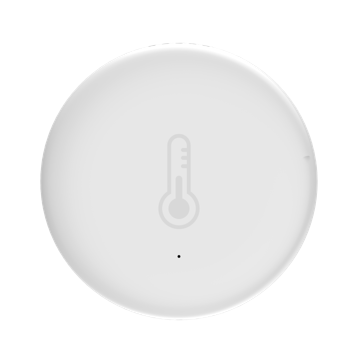
The temperature and humidity sensor is a consumer electronic product and applies to indoor environment monitoring. The following figure shows a sample product.
Application scenarios
Main scenarios
Homes, offices, hotels, apartments, schools, hospitals, nursing homes, shopping malls, restaurants, banks, and warehouses.
Scenario features
-
Remote monitoring of temperature and humidity data. For example, the suitable indoor temperature for an infant’s room in summer is 23°C to 28°C.
-
Automated linkage with environmental appliances. For example, the air conditioner turns on automatically when the office temperature drops below 10°C in winter.
-
Notifications when temperature or humidity exceeds the threshold. For example, the system reminds users to turn on the air conditioner when the temperature in a shopping mall exceeds 30°C.
-
Historical statistics for temperature and humidity. For example, electronic materials stored in a warehouse must remain at a constant temperature of −5°C to 30°C year-round.
Is this page helpful?
YesFeedbackIs this page helpful?
YesFeedback