

Tuya DuckyClaw Released!
Tuya DuckyClaw Released: Accelerating OpenClaw’s Entry into the Physical World, Letting AI Agents Truly Take Over Everything
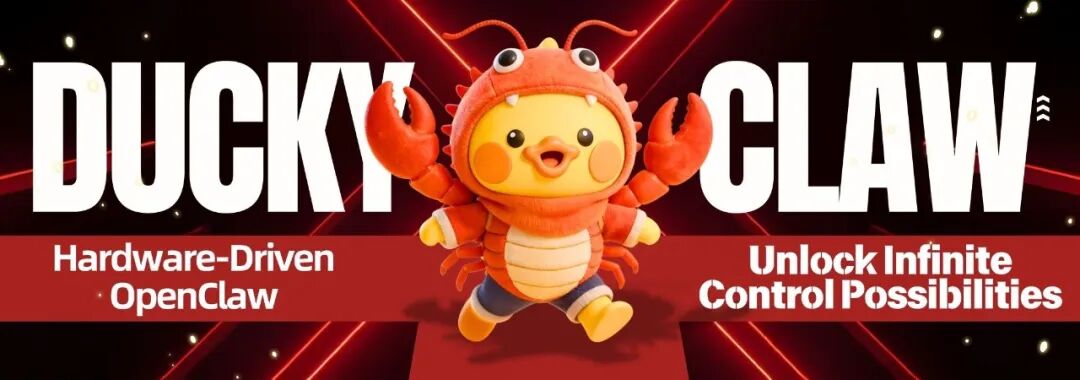
Figure: DuckyClaw — AI Agent embedded deployment framework for the physical world
After OpenClaw went viral, the most frequently asked question in the developer community wasn’t "how to install it," but: Can this thing run on my board?
This question hides an extremely clear industry signal. When people install OpenClaw, they’re not installing a chat app —
They’re installing an AI automation node capable of autonomous perception, autonomous decision-making, and autonomous execution. And nodes, by nature, should exist in the physical world, not just live in a Mac Mini’s memory.
Therefore, the recent wave of "various Claws running on embedded hardware" technical explorations is not developer trickery, but a genuine market demand seeking an outlet:
The next main battlefield for AI Agents is the physical world.
But the problem is, the road to the physical world is far more complex than getting a demo running.
Stuffing OpenClaw into an ESP32 or Raspberry Pi is Proof of Concept — proving "it can run." But from "can run" to "runs well," "runs usefully," and "truly controls hundreds of millions of smart devices in the real world," there lies a complete systems engineering gap, and even more so, a hardware ecosystem barrier that takes a decade of accumulation to form.
DuckyClaw was born to bridge this last mile.
01 What is DuckyClaw? Let’s Start with What It’s Not
DuckyClaw is not an extreme performance experiment of "compressing large models on low-power chips."
It’s also not a hardware product that repackages OpenClaw with a different shell and a different board.
DuckyClaw is an AI Agent embedded deployment framework for developers, with on-device hardware/development boards as the core hardware carrier and the Tuya AI Cloud Platform as the backend foundation.
It answers only one core question:
When an AI Agent needs to perceive, decide, and control real physical devices, which technology stack should developers build on?
The answer cannot be just a development board.
02 Architecture First: Understanding DuckyClaw’s Three-Layer Structure
To understand DuckyClaw’s differentiation, you first need to understand its overall architecture design.
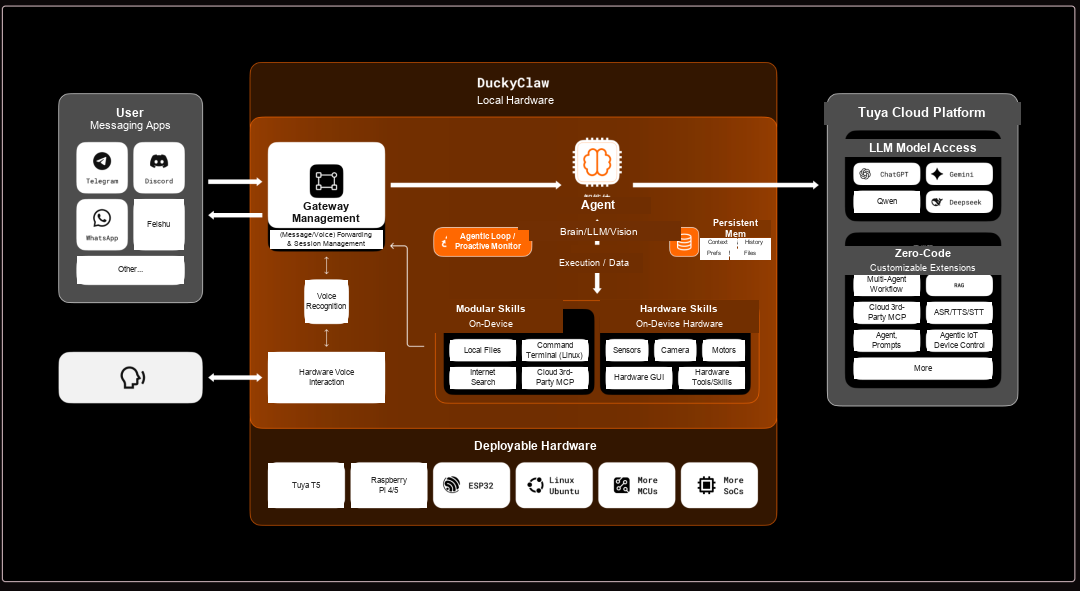
Figure: DuckyClaw three-layer architecture — Local Hardware Execution Layer, Agentic Loop & Proactive Monitoring Layer, and Tuya AI Cloud Platform
Layer 1: Local Hardware Execution Layer
This is the Agent’s "body" in the physical world.
DuckyClaw is natively built on the TuyaOpen C SDK, without depending on Node.js or Python frameworks. This means the same C codebase can seamlessly deploy across MCU (Tuya T5AI module / ESP32), SoC (Raspberry Pi 4/5 / ARM Linux), and PC (Ubuntu) platforms — something other "porting OpenClaw to embedded" solutions cannot achieve at the architecture level. OpenClaw depends on the Node.js runtime, MimiClaw is limited to the ESP32-S3 single platform, while DuckyClaw covers the complete hardware spectrum from ARM Cortex-M to ARM Cortex-A to x64 with a single codebase.
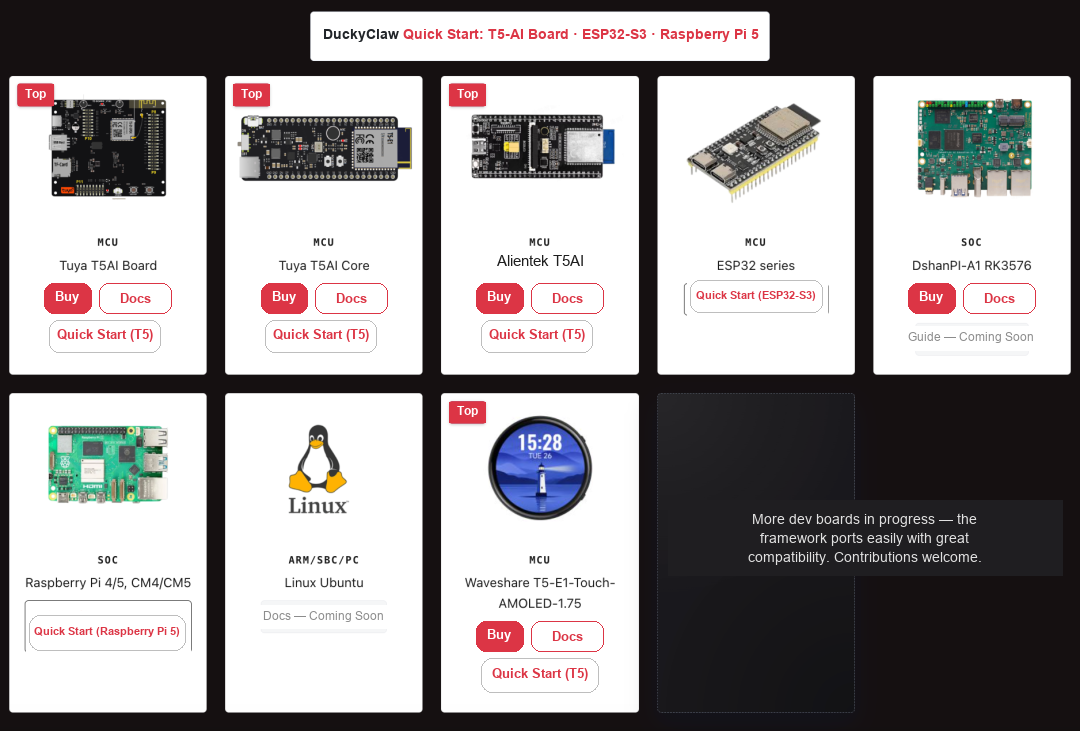
Figure: DuckyClaw core components — Gateway, Agent Brain/LLM/Vision, Persistent Memory, Modular Skills (On-Device + Hardware Skills)
Core components include:
● Gateway (Unified Perception Gateway): Aggregates mainstream communication channels such as Telegram, Discord, and Feishu, as well as local voice ASR input, routing uniformly to the Agent decision core without depending on single platform lock-in.
● Agent Brain / LLM / Vision: Reasoning and decision hub, supporting integration with mainstream large models, capable of both calling cloud computing power and local inference through AgentLoop.
● Persistent Memory: Stores context, user preferences, history, and local file systems — the Agent has memory, it’s not a stateless tool that resets on every restart. Worth special mention, DuckyClaw also maintains dedicated IoT Memory, continuously recording device status, control operation history, and user automation preferences, enabling the Agent’s understanding of physical devices to accumulate over time — this is not a static configuration file but an evolving device cognition layer, a capability that pure software Agents inherently lack.
● Modular Skills (On-Device Skills): Local file system, Linux command terminal, internet search, MCP protocol integration — the execution hands of the digital world.
● Hardware Skills: Developers can highly extend the hardware capabilities they desire, with deep integration with large models.
These two sets of "skills" are the design most worth developers’ attention in the DuckyClaw architecture. It unifies digital execution and physical execution under the same framework, driving the Agent through the Agentic Loop to freely traverse between the digital and physical worlds. This is a rare complete closed loop among existing embedded AI solutions.
Layer 2: Agentic Loop and Proactive Monitoring Layer
DuckyClaw is not a passive responsive chatbot.
It features a built-in Agentic Loop and Proactive Monitoring mechanism. The Agent can continuously run in the background, proactively sense status changes, and autonomously trigger actions — without requiring human manual wake-up each time, and without maintaining foreground interaction.
This is the critical transition from "tool" to "Agent," and also DuckyClaw’s core value proposition for industrial and commercial scenarios. Like a person, DuckyClaw can proactively trigger and initiate conversations and suggestions.
Layer 3: Tuya AI Cloud Platform
This is the fundamental advantage that distinguishes DuckyClaw from all other solutions.
Tuya Cloud provides not just cloud computing power hosting, but a complete developer infrastructure:
● Unified Large Model Access: A single TuyaOpen Key enables calling mainstream large models including GPT / Gemini / Qwen / DeepSeek, without separately applying for APIs or managing multiple sets of keys. Model switching can be completed through the conversation interface.
● Zero-Coding cloud expansion capability with extremely strong extensibility, achieving without relying solely on on-device capabilities:
-
Multi-Agent Workflow Orchestration
-
RAG Knowledge Retrieval Augmentation
-
ASR / TTS / STT Full-Chain Voice
-
Cloud Third-Party MCPs
-
Tuya Agentic IoT Control (Tuya IoT Intelligent Control Interface)
03 Why Can Tuya Do This When Others Can’t?
Let’s ask a direct question: Similarly running OpenClaw on embedded hardware, what’s the essential difference between DuckyClaw and other solutions?
In one sentence: Behind Tuya lies a genuinely operating AI+IoT ecosystem.
Over the past decade, Tuya has accumulated a smart hardware ecosystem covering hundreds of categories globally — lights, outlets, door locks, cameras, sensors, air conditioners, home appliances… These aren’t future product roadmaps; they’re hardware networks genuinely running in the homes of consumers and enterprise customers worldwide today.
When DuckyClaw runs on a T5AI development board and connects to Tuya’s device network through the IoT device control MCP tool, it controls not a simulated virtual light bulb — it can orchestrate real cross-brand, cross-protocol devices in Tuya’s connected ecosystem, achieving full-category interoperability.
This means an AI Agent built on DuckyClaw can:
● Continuously monitor sensor data, proactively sensing environmental changes
● Based on preset logic or real-time LLM reasoning, autonomously control networked devices to execute physical actions
● Proactively push status reports to users through channels like WhatsApp, Telegram, and Feishu, and respond to remote commands
● Complete cross-device, cross-brand complex linkage tasks in unattended situations
This is not the logic of "an AI assistant helping you send emails" — this is the genuine deployment of AI Agents as physical world execution nodes.
And all this relies on the global AI+IoT developer ecosystem that Tuya has built and continuously operated for a decade — a first-mover barrier that no solution starting from scratch and solely doing hardware adaptation can replicate in a short time.
04 Hardware-Driven DuckyClaw,
Unlocking Infinite Possibilities for Agentic Hardware
Currently, OpenClaw’s Skill ecosystem mostly solves digital world automation — writing code, sending emails, organizing documents, searching information, etc. These scenarios have value, but they’re essentially AI-transforming existing software workflows — changing efficiency, not the paradigm.
The real incremental market lies in what AI Agents can do after entering the physical world: industrial equipment monitoring, smart building energy management, agricultural sensor linkage, commercial space automation… The market scale of these scenarios is orders of magnitude larger than "helping programmers write code."
DuckyClaw’s cloud-device collaborative architecture — "local execution + cloud intelligence" — is an engineering solution tested and proven in real scenarios.
When developers start building hardware skill packs for DuckyClaw targeting specific scenarios, this ecosystem’s value will rapidly flywheel, forming structural barriers against single-hardware solutions.
Give every device node an AI Agent brain that can think, letting it act as an agent for devices to complete perception, reasoning, and action. With a decade of hardware ecosystem accumulation, Tuya stands at the forefront of this reconstruction.
Tuya DuckyClaw is now open source. Copy the links below and start building your AI Agent now:
- Details page: https://tuyaopen.ai/zh/duckyclaw
- Open source repository: https://github.com/tuya/DuckyClaw
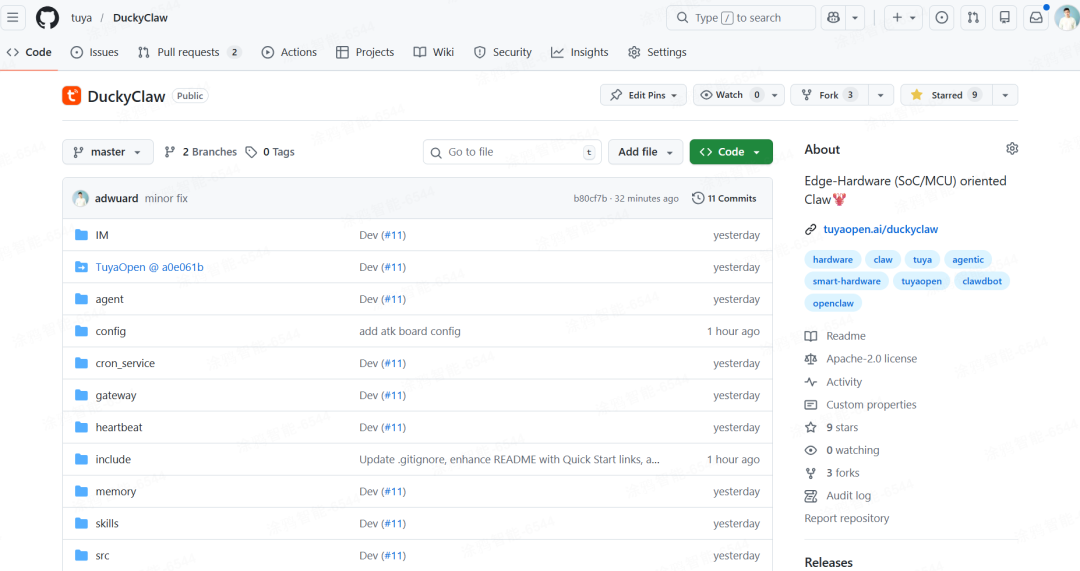
Figure: DuckyClaw open source — visit tuyaopen.ai/zh/duckyclaw or github.com/tuya/DuckyClaw to get started
Is this page helpful?
YesFeedbackIs this page helpful?
YesFeedback