

Tuya Successfully Breaks Through Kilometer-Level Bluetooth Low Energy Long Range Technology!
Tuya Successfully Breaks Through Kilometer-Level Bluetooth Low Energy Long Range Technology! Ultra-Compatible with Long Range + Traditional Mode
Bluetooth LE Long Range is an important achievement born during the continuous evolution of Bluetooth technology. It was first introduced in the Bluetooth 5.0 protocol, aimed at breaking through the communication distance limitations of traditional Bluetooth Low Energy (Bluetooth LE) technology. Under the same conditions, traditional Bluetooth LE technology only has a communication range of 10-30 meters, while Bluetooth LE Long Range technology optimizes signal transmission to enable Bluetooth devices to achieve more reliable connections and data transmission over longer distances. In actual outdoor environments, its communication range can extend to 1 kilometer (up to 2 kilometers in ideal conditions).
The emergence of this technology has greatly expanded the application scenarios of Bluetooth technology, for example:
-
Smart Buildings: Remote monitoring and management of building equipment
-
Industrial Automation: Long-distance sensor data collection, building factory-level sensor networks
-
Smart Agriculture: Meeting large-area farmland environment monitoring needs
-
Cold Chain Logistics: Ensuring uninterrupted temperature and humidity tracking throughout the journey
By breaking through physical distance limitations, Bluetooth LE Long Range technology provides a more economical and reliable wireless connectivity solution for the scaled deployment of intelligent devices, strongly driving the evolution of traditional industries toward intelligence.
I. How Does Bluetooth Low Energy Long Range Technology Work?
The core of Bluetooth LE Long Range’s ability to achieve long-distance communication lies in the introduction of a new Coded PHY option at the physical layer in the Bluetooth 5.0 protocol. Unlike the one-to-one transmission of traditional 1M PHY mode, Coded PHY primarily improves signal transmission reliability and distance by adding redundant information:
- Encoding Rules: Each information bit is represented by multiple symbols. For example, when s=2, 2 symbols are used for identification; when s=8, 8 symbols are used for identification
- Rate Variation: The effective rate is reduced. For example, when s=2, the rate is 1M/2=500Kbps; when s=8, the rate is 1M/8=125Kbps
Although transmission speed decreases, this redundant encoding method allows the receiver to repair signal errors through forward error correction (FEC) algorithms, significantly improving anti-interference capability and thereby achieving stable kilometer-level long-distance communication.
The table below clearly summarizes the modulation schemes, encoding schemes, and data rate parameters of different physical layers (PHY) in Bluetooth Low Energy technology, helping everyone better understand:
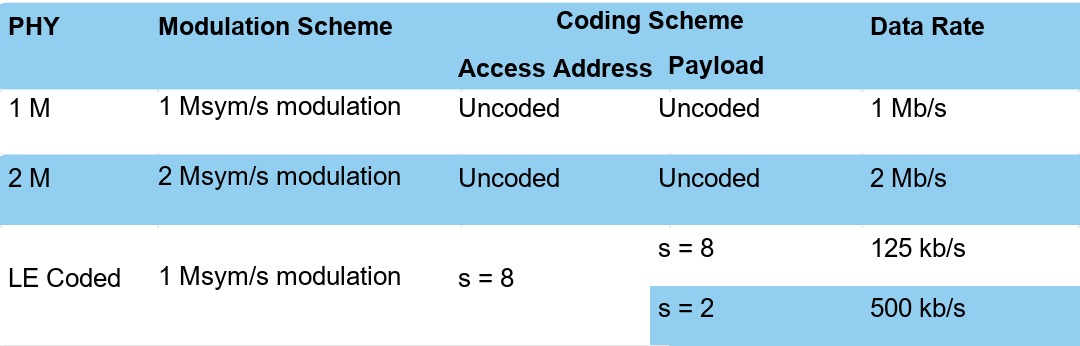
Figure: Comparison table of Bluetooth LE physical layer (PHY) modulation schemes, encoding schemes, and data rate parameters — including 1M PHY, Coded PHY (s=2), and Coded PHY (s=8)
II. Tuya Further Revolutionizes Bluetooth Long Range Transmission Technology
Bluetooth LE Long Range is an optional feature of Bluetooth 5.0 and later versions, but currently not all smartphones or smart devices on the market can support it; even if they support Long Range mode, they cannot simultaneously be compatible with traditional mode. Therefore, based on the TuyaOS operating system (click to see what makes TuyaOS powerful?), Tuya has fully upgraded Bluetooth LE Long Range technology. After developers integrate this technology into devices or phones, they can seamlessly switch between Long Range mode and traditional mode.
For example: A device can communicate with phones that don’t support Long Range through traditional mode; it can also perform long-distance communication with Tuya-supported gateways/phones based on Long Range mode. By integrating Tuya’s Bluetooth technology, developers and brand owners can quickly achieve the market launch of the industry’s first batch of Bluetooth LE Long Range devices, seizing market opportunities early!
The specific Bluetooth chips and gateway module models supported by Tuya are as follows:
- Bluetooth Sub-Device Long Range Recommended Chips: TI CC2340, SILICON LABS BG24
- Bluetooth LE Long Range Gateway Type: CR3L With Long Range
CR3L is a low-power embedded Wi-Fi module developed by Tuya, consisting of a highly integrated wireless RF chip with built-in Wi-Fi network protocol stack and rich library functions. Paired with the CC2340 Bluetooth chip, it can simultaneously support Long Range mode and traditional mode.
III. How to Develop Tuya Bluetooth-Related Technologies?
1. How to Download the Bluetooth LE Long Range Sub-Device Development Framework?
You can obtain the Bluetooth LE Long Range Sub-Device SDK through Tuya Wind IDE. The specific process is as follows:
1.1 Install the Tuya Wind IDE plugin and learn about the TuyaOS development process:
https://developer.tuya.com/cn/docs/iot-device-dev/tuyaos-wind-ide?id=Kbfy6kfuuqqu3
1.2 Launch Tuya Wind IDE, click "Create Development Framework," and select according to the image below to create the development framework.
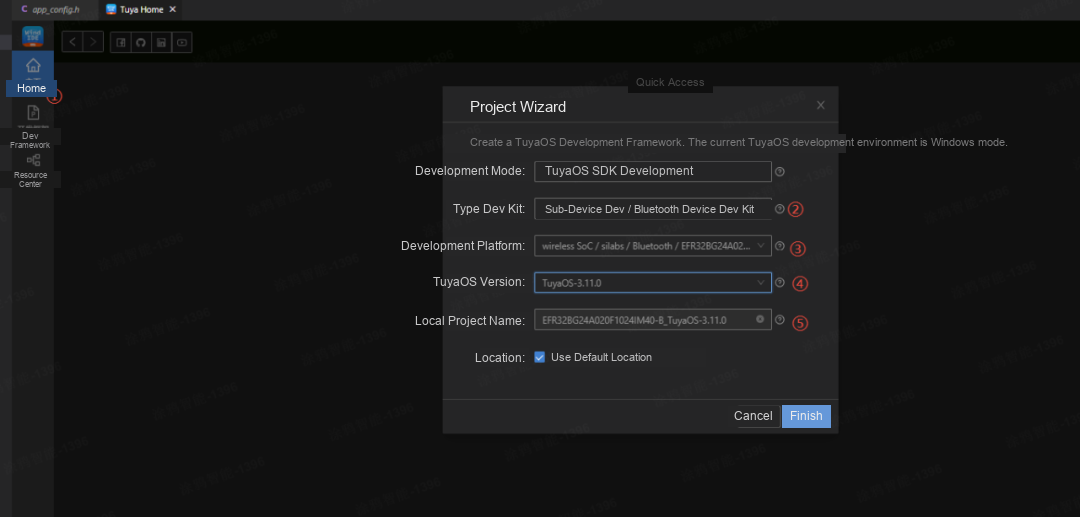
Figure: Creating the Bluetooth LE Long Range Sub-Device development framework in Tuya Wind IDE
1.3 One-Click Compilation
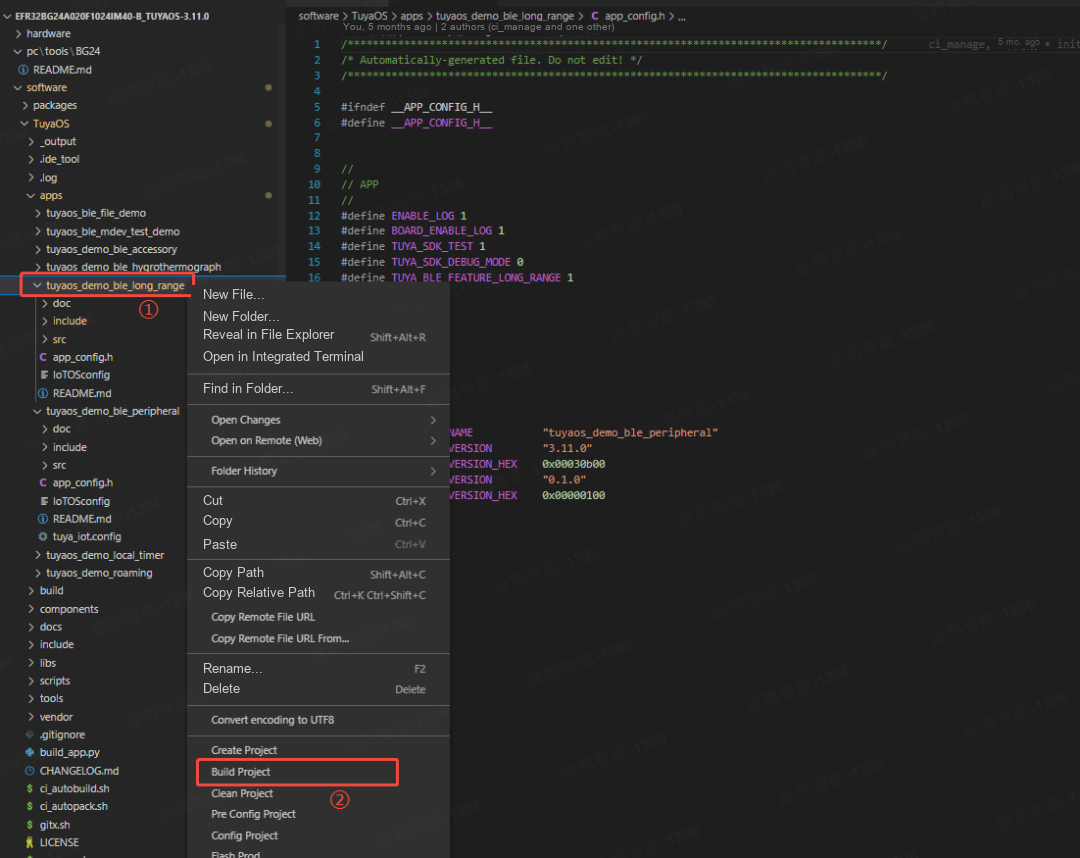
Figure: One-click compilation of the Bluetooth LE Long Range Sub-Device SDK
2. How to Download the Bluetooth LE Long Range Gateway Development Framework?
You can obtain the Bluetooth LE Long Range Gateway SDK through Tuya Wind IDE. The specific process is as follows:
2.1 Install the Tuya Wind IDE plugin and learn about the TuyaOS development process:
https://developer.tuya.com/cn/docs/iot-device-dev/tuyaos-wind-ide?id=Kbfy6kfuuqqu3
2.2 Launch Tuya Wind IDE, enter the "Resource Center," and select according to the image below to apply for development framework permission. Fill in Tuya’s business email (business email: zouxk@tuya.com) and submit the application.
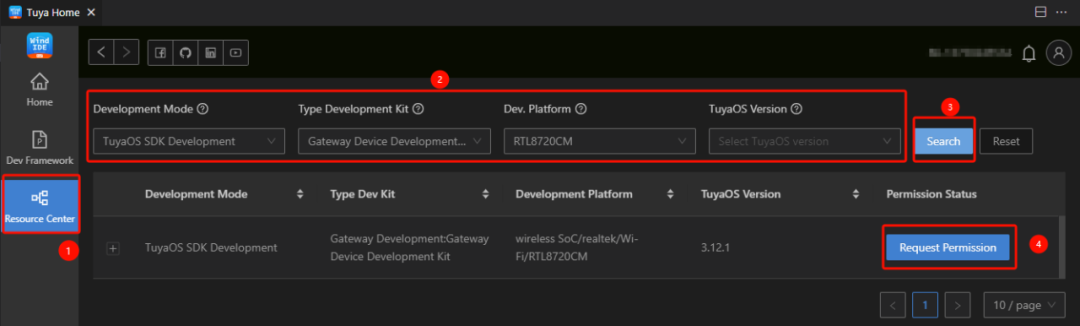
Figure: Applying for Bluetooth LE Long Range Gateway development framework permission in the Tuya Wind IDE Resource Center
2.3 After approval, enter the homepage, click "Create Development Framework," and select according to the image below.
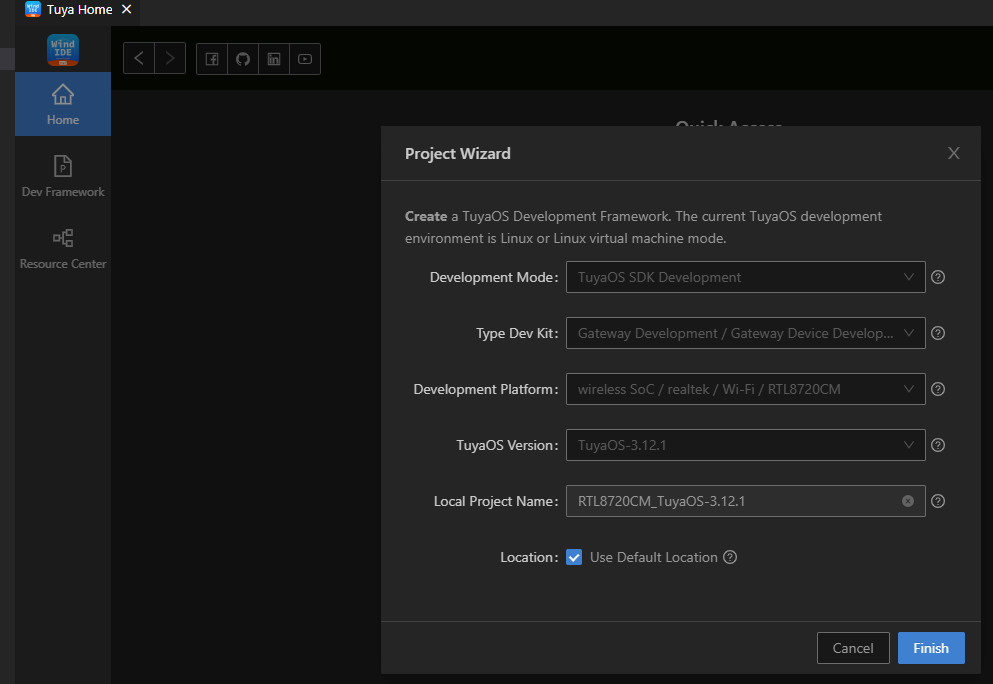
Figure: Creating the Bluetooth LE Long Range Gateway development framework — select platform and framework options
2.4 One-Click Compilation
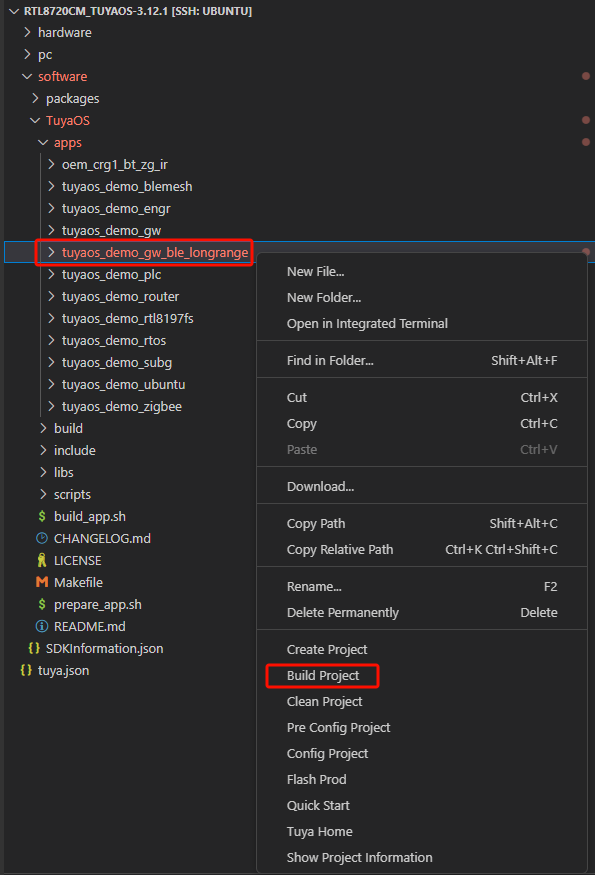
Figure: One-click compilation of the Bluetooth LE Long Range Gateway SDK
IV. What to Do If You Encounter Issues During Development?
If you encounter any issues during the development process, you can ask questions on the two developer forums below, where technical staff will assist you promptly.
1. Gateway Issues Forum
Chinese:
https://www.tuyaos.com/viewforum.php?f=13
English:
https://www.tuyaos.com/viewforum.php?f=29
2. Bluetooth Sub-Device Issues Forum
Chinese:
https://www.tuyaos.com/viewforum.php?f=12
English:
https://www.tuyaos.com/viewforum.php?f=26
Is this page helpful?
YesFeedbackIs this page helpful?
YesFeedback