

Tuya Breakthrough Solution for Bluetooth Mesh Firmware Batch Upgrade Challenge!
Tuya Breakthrough Solution for Bluetooth Mesh Firmware Batch Upgrade Challenge! One-Click Network-Wide Upgrade in Just 10 Minutes
I. The Transformative Significance of Bluetooth Mesh
Bluetooth mesh is a decentralized mesh network protocol developed by the Bluetooth SIG based on Bluetooth Low Energy, specifically designed for large-scale device networking, aimed at addressing the limitations of traditional Bluetooth point-to-point communication. By combining many-to-many communication, self-organizing networks, and multi-hop relay technologies, a single Mesh network can support up to thousands of nodes, with coverage extending to the kilometer level, easily achieving seamless interconnection between smart devices.
For example, if a phone and a smart light bulb use traditional Bluetooth point-to-point communication, the signal would deteriorate due to excessive distance, unable to execute the phone’s commands in time. Through Bluetooth mesh, the light bulb group or other smart devices would automatically form a "mutual aid team," relaying the phone’s commands from near to far; even if one smart device fails, it can automatically find alternative routes for signal transmission, ultimately achieving wide-area coverage, high reliability, and low-power intelligent communication.
Since its release in 2017, Bluetooth mesh has reconstructed the last mile of intelligent connectivity through the triangular architecture of "low power + self-organizing network + standardization." With its characteristics of large-scale device management, high reliability, and flexible deployment, it has become a core connectivity technology in the intelligent field, natively supported by over 96% of smartphones globally, and is comprehensively driving intelligent upgrades in smart home, industrial automation, smart city, and other scenarios.
II. The Significance and Challenges of Mesh Network Firmware Upgrades
In intelligent systems, whether for feature iteration or issue resolution, firmware upgrades are a common approach. However, for Mesh networks with numerous devices and interdependent nodes, firmware upgrades face many challenges. For example, how to make thousands of nodes work collaboratively, avoid network congestion, and ensure normal network operation during upgrades — especially in industrial scenarios where "zero downtime" must be achieved. Additionally, the upgrade process needs security protection mechanisms to prevent firmware tampering and verify its integrity and legitimacy; even if upgrades fail, rollback mechanisms must be in place to ensure system recoverability. Overall, these challenges can be summarized as follows:
1. Upgrade Complexity in Large-Scale Networks
- Large-scale node upgrades easily cause "broadcast storms" (i.e., flooding-style upgrades causing network congestion)
- Efficiency issues from overly long upgrade cycles
2. How to Ensure Upgrade Process Reliability
- Industrial scenarios require "zero downtime" — seamless switching during upgrades
- Multi-hop transmission may cause upgrade package loss
3. Storage Resource Constraints
- Insufficient storage space: Limited Flash resources on device side
4. Security Risks
- Firmware integrity: Need to prevent man-in-the-middle tampering (e.g., upgrade packages implanted with malicious code)
- Authentication and authorization: Device identity verification to ensure only legitimate nodes can receive upgrade packages
5. Ecosystem Fragmentation and Standardization
- Multi-vendor compatibility: Differences in chip architectures and systems
- Version compatibility: Message interoperability between old and new firmware coexistence depends on standardized backward-compatible design
6. Scenario-Specific Challenges
- Industrial real-time requirements: Production line device upgrades must avoid production periods and support remote upgrade capability
- Smart city: Outdoor devices (street lights, manhole cover sensors) require enhanced firmware transmission anti-interference capability to withstand temperature, humidity, and other environmental interference, ensuring stable transmission
Therefore, Mesh network firmware upgrades need to balance not only large-scale, multi-node collaboration and reliability but also fully consider security, resource constraints, and practical needs in different scenarios to achieve efficient, stable, and controllable upgrade processes.
III. Tuya Successfully Breaks Through Bluetooth Mesh Group Upgrade Technology
Tuya has launched the Bluetooth Mesh 2.1 Group Upgrade Solution (click to see what other features Tuya’s Bluetooth Mesh 2.1 has?), achieving major breakthroughs across all performance metrics. Through layered multicast and progress monitoring technology, it successfully helps developers reduce the total batch upgrade time to under 10 minutes; it also supports remote management of group upgrade functions, meeting upgrade requirements in various complex scenarios. Even if an upgrade fails, Tuya supports automatic system rollback to the previous version, ensuring smart devices are never affected by upgrades.
This solution is widely applicable to lighting, electrical, sensing, and other fields. Combined with multiple security verification mechanisms, it meets upgrade requirements in large-scale scenarios such as industrial and smart city applications, bringing developers and users a smarter, more convenient, and efficient connectivity experience.
Watch the video to experience how Tuya quickly upgrades 100 smart devices in 10 minutes:
1. Successfully Reducing Upgrade Complexity in Large-Scale Networks
- Addressing the network congestion caused by large-scale Bluetooth mesh network upgrades, TuyaOS employs layered multicast and progress monitoring technology, effectively mitigating the impact of network storms;
- In terms of large-scale mesh network upgrade speed, this solution upgrades 100 devices in just over ten minutes. Compared to the industry’s typical upgrade times of several hours, Tuya demonstrates stronger competitiveness in large-scale networking efficiency.
2. Effectively Ensuring Upgrade Process Reliability
- Seamless Switching: Leveraging Tuya’s dual Bank architecture, supporting automatic rollback to the previous version after upgrade failure;
- Transmission Stability: Through ACK acknowledgment and retransmission mechanisms, successfully resolving the issue of upgrade package loss in multi-hop networks, significantly improving upgrade success rates.
3. Storage Resource Constraints
Tuya has added support for firmware compression storage mechanisms, significantly reducing the occupation of device Flash space.
4. Security Risks
- Data Encryption: Based on Tuya’s powerful Bluetooth mesh security encryption algorithms, developers can ensure secure encrypted transmission of upgrade files;
- Legitimacy Verification: Firmware legitimacy and integrity verification based on digital signatures, with one-device-one-key authentication mechanisms ensuring only authorized devices can be upgraded.
5. Ecosystem Fragmentation and Standardization
- Based on TuyaOS (click to learn about TuyaOS’s powerful capabilities) cross-platform, standardized Kernel Layer API (TKL) design, this solution automatically adapts to differences between chip architectures, providing a stable, reliable, and consistent operating environment for upper-layer software;
- Based on version negotiation mechanisms, supporting compatibility handling between different versions.
6. Scenario-Specific Challenges
- Supports remote group management upgrades, helping developers achieve upgrade requirements in different scenarios;
- Based on multiple verification mechanisms, improving firmware transmission reliability. Meeting the strict requirements of industrial and smart city environments.
IV. Obtaining the Tuya Bluetooth Mesh Development Framework
Through Tuya Wind IDE, developers can directly obtain the TuyaOS Bluetooth LE Mesh development framework. The specific process is as follows:
- Install the Tuya Wind IDE plugin and learn about the TuyaOS development process:
https://developer.tuya.com/cn/docs/iot-device-dev/tuyaos-wind-ide?id=Kbfy6kfuuqqu3
- Launch Tuya Wind IDE, enter the "Resource Center," select as shown in the image below to apply for development framework permission, and click to submit the application.
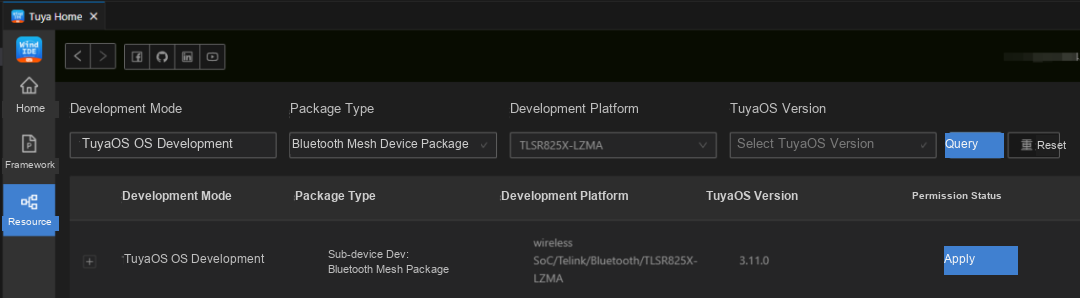
Figure: Step 2 — Apply for Bluetooth Mesh development framework permission in the Tuya Wind IDE Resource Center
- After approval, enter the homepage and click "Create Development Framework."
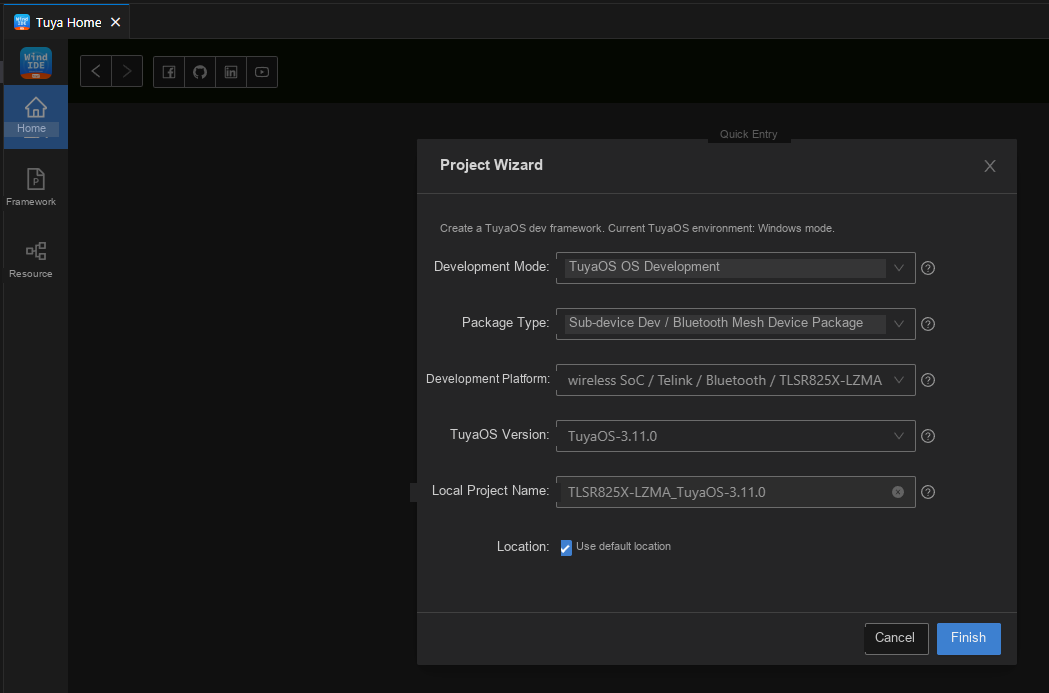
Figure: Step 3 — Create the Bluetooth Mesh development framework
- One-Click Compilation
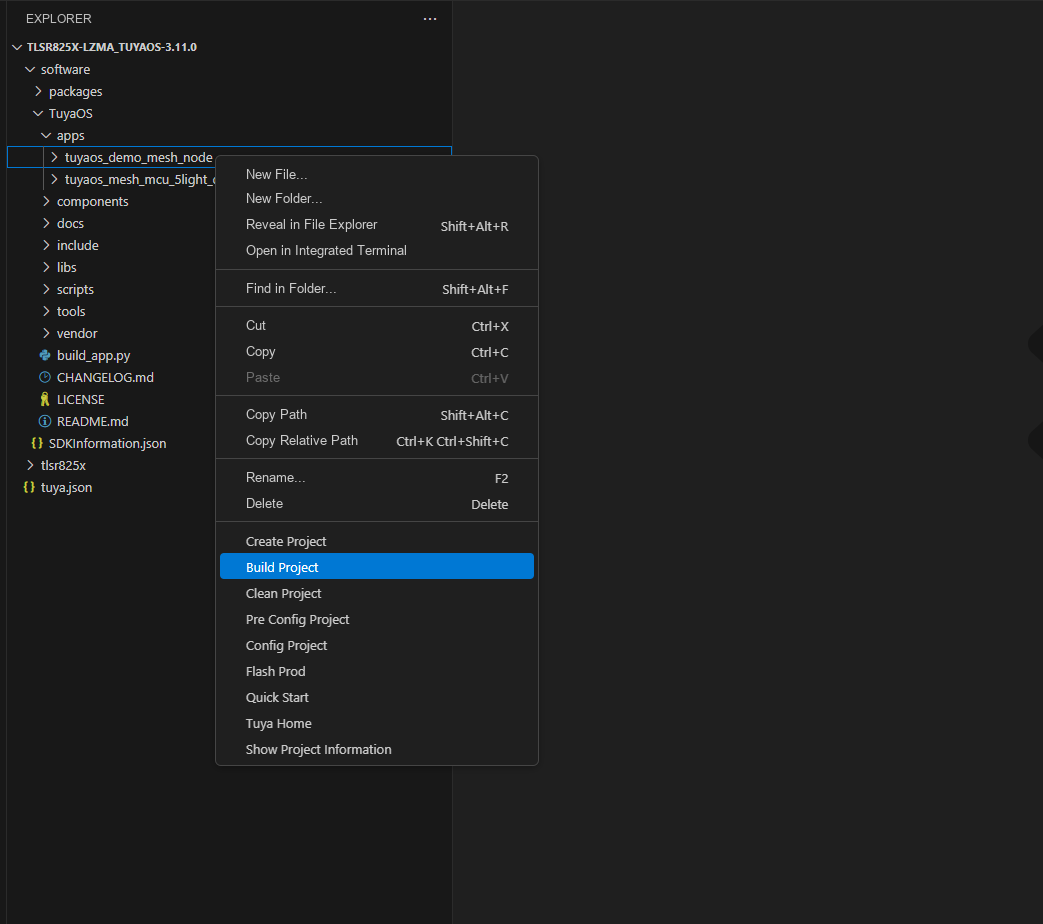
Figure: Step 4 — One-click compilation of the Bluetooth Mesh development framework
- Currently, group upgrades require pairing with Tuya’s dual-link Bluetooth gateway. Gateway-free scenario support will be available in the future — stay tuned.
V. Developer Q&A
If you encounter any issues during development, you can log in to the Tuya Developer Forum to ask questions, where technical staff will assist you at any time:
https://www.tuyaos.com/viewforum.php?f=2
Is this page helpful?
YesFeedbackIs this page helpful?
YesFeedback