

Tuya TVS 5.0 System Breaks Through Audio-Video Core Technology!
Tuya TVS 5.0 System Breaks Through Audio-Video Core Technology! Ultra-Low Latency + Anti-Packet-Loss Capability Reaches New Heights
With the rapid development of the intelligent era, the demand for real-time audio-video transmission continues to grow in areas such as whole-home smart, industrial monitoring, security, and AI detection. However, traditional streaming technology solutions face a series of severe challenges in complex intelligent environments, including limited device resources, complex network conditions, and high real-time requirements.
Addressing these challenges, Tuya has innovatively launched the next-generation real-time streaming transmission solution — TVS 5.0, based on years of deep accumulation in the intelligent field. Through unique technical innovation, Tuya is committed to setting a new industry standard for real-time audio-video transmission.
I. Tuya Achieves Modular Architecture Design
Tuya’s TVS 5.0 system adopts a modular architecture design, primarily comprising four core modules: network perception, transmission management, path selection, and security protection. Through proprietary network bandwidth prediction algorithms and a transmission management engine, it provides developers with closed-loop management from network environment perception to transmission strategy optimization, building a transmission system that can efficiently adapt to various complex intelligent scenarios, while significantly improving overall system stability.
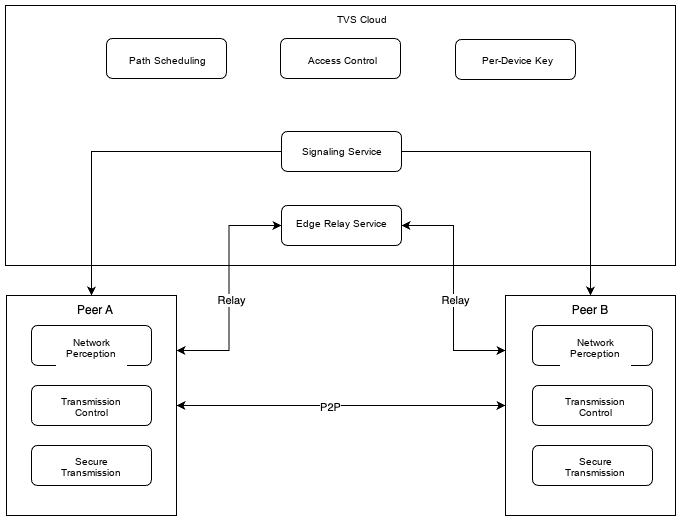
Figure: TVS 5.0 System Technical Architecture — showing the four core modules: Network Perception, Transmission Management, Path Selection, and Security Protection
Compared to traditional solutions, Tuya’s TVS 5.0 system has achieved technical breakthroughs in four key areas:
1. Real-Time Network State Modeling
This system is suitable for mobile devices like robot vacuums where network conditions change rapidly. It features a network quality prediction model that updates network status every 200ms and performs real-time precise identification of edge network characteristics, facilitating the selection of more accurate transmission management strategies.
2. Automatic Transmission Mode Switching
It supports seamless switching between P2P/Relay/hybrid modes, with an average switching latency of < 50ms. The implementation principle leverages Tuya’s globally deployed edge acceleration node network to achieve the following effects:
-
Automatically select the optimal Relay node and transmission path;
-
In complex scenarios such as cross-regional and cross-ISP, the average end-to-end latency is reduced to 300ms;
-
Hybrid mode also accelerates connection speed, with average connection time under 100ms, showing more competitive advantages compared to similar technologies on other platforms.
3. Multi-Dimensional QoS Management Mechanism
The multi-dimensional QoS management mechanism can dynamically coordinate parameters such as bandwidth utilization, transmission latency, and image quality level, achieving intelligent quality balance. It maintains a 98.6% video frame data integrity rate even under 60% packet loss.
4. Device Resource Adaptation Algorithm
This system can automatically select the optimal transmission strategy based on device computing power, memory, energy consumption, and other parameters, achieving precise matching while maximizing transmission quality and minimizing resource consumption.
II. Tuya Breaks Through Audio-Video Transmission Core Technology
1. Automatically Selecting Intelligent Transmission Strategies
The TVS 5.0 system adopts Tuya’s self-developed bandwidth prediction algorithm, breakthrough-ly improving bandwidth prediction accuracy to over 95%. It features a proprietary transmission protocol integrating forward error correction, intelligent retransmission, and adaptive bitrate — three technologies forming a collaborative working mechanism:
-
Dynamic FEC Matrix: Automatically adjusts FEC redundancy coefficients based on network packet loss characteristics, maintaining video smoothness even under 60% packet loss;
-
Intelligent Retransmission Strategy: Automatically ranks content importance in tiers and establishes a hierarchical retransmission mechanism, supporting key packet priority retransmission and fast retransmission;
-
Bitrate Adaptive Engine: Supports dynamic adjustment from 0.5-10Mbps, with response time reduced to 300ms.
Experimental data shows that TVS 5.0 rapidly improves effective bandwidth utilization by 20% in typical intelligent scenarios, while reducing transmission bandwidth requirements by 15% at the same image quality:
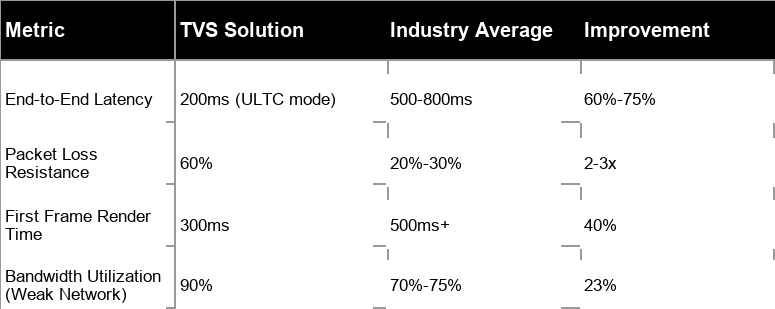
Figure: TVS 5.0 performance comparison — effective bandwidth utilization improved by 20%, transmission bandwidth requirements reduced by 15% at the same image quality
2. Building High-Priority + Ultra-Low Latency Transmission Channels
For vertical scenarios with high real-time requirements such as smart door locks and device management, Tuya has developed the ULTC (Ultra-Low Latency Channel) dedicated ultra-low latency transmission channel. Through the following innovations, average latency under weak network conditions is rapidly reduced by 50%, with 40% lower bandwidth overhead compared to the KCP protocol:
-
For high-priority data packets like control commands, a dedicated "green channel" is established to ensure packets are sent with priority;
-
Combining UDP fast transmission with lightweight reliable guarantee mechanisms, end-to-end latency is stabilized within 200ms;
-
Even in lab-simulated weak network environments (e.g., 30% packet loss, 100ms jitter), the ULTC channel maintains reliable transmission latency within 250ms, meeting the stringent requirements of industrial-grade management scenarios.
3. Full-Chain Security Protection System
In terms of data security, Tuya’s TVS 5.0 system has built a security protection solution covering the entire lifecycle.
3.1 Multi-Layer Encryption Ensures Signaling Communication Security
Adopts multi-layer key protection to maximize data transmission security and prevent data theft.
- First Layer: Establishes transmission channels based on TLS 1.2 protocol, achieving forward secrecy through ECDHE key exchange, ensuring key temporality even during communication;
- Second Layer: Business data is encrypted using AES-128-GCM algorithm. This algorithm has successfully passed NIST-certified AEAD mode, simultaneously ensuring data confidentiality and integrity; its main principle is based on device and user identity to generate dual-factor keys, where multi-layer encryption guarantees key uniqueness.
3.2 Dual Authentication Mechanism
In addition to relying on the reliable signaling communication link, the end-to-end transmission process also requires mandatory verification of relevant information, including temporary usernames and passwords (both generated based on the device’s unique key and set permission information). Meanwhile, the terminal generates dedicated local authentication information locally, which constitutes the second layer of security authentication end-to-end. Only after completing both security authentications can developers successfully create a TVS link.
3.3 End-to-End Encryption
The system adopts a "one-device-one-key" base key (EK) and temporary session key (TSK) dual protection mechanism. Each session terminal generates new random encryption keys to ensure communication encryption security. This key is distributed end-to-end, and cloud services cannot store or perceive it, effectively ensuring data security. Meanwhile, transmitted data is built based on HMAC-SHA256 message authentication mechanisms, with robust technical barriers that can prevent man-in-the-middle attacks.
The TVS solution features industry-leading data security and privacy compliance technology, meeting and holding multiple internationally authoritative third-party certification certificates and audit reports. The certification certificates obtained are shown below:
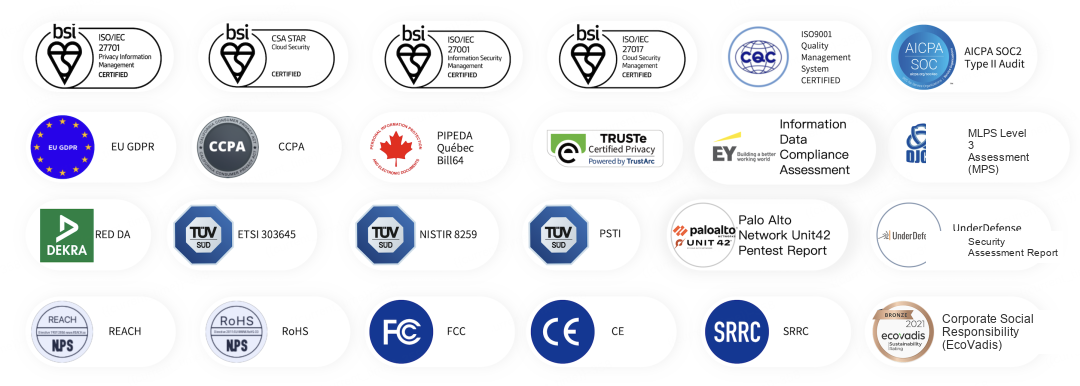
Figure: International security certifications and audit reports obtained by the TVS solution
III. Scaled Application Cases
Currently, Tuya’s TVS 5.0 system has achieved scaled application in multiple fields and has received broad recognition from brand customers:
-
Smart Home: In low-quality network environments (>50% packet loss), it still supports stable 4K ultra-HD video transmission with latency controlled within 200ms;
-
AI Scenarios: In integrated cloud-device transmission + inference scenarios, overall processing latency is reduced by 20%, and AI conversation latency can be controlled within 1s;
-
Automotive Systems: Supports HD video transmission in 80km/h mobile scenarios;
-
Security Monitoring: Through intelligent pre-buffering mechanisms, recording integrity reaches 99.9% even in weak network environments.
IV. Developer Q&A
If you encounter any issues during development, you can leave questions on the Tuya Developer Forum, where technical staff will assist you promptly.
Tuya Developer Forum address:
https://www.tuyaos.com/viewforum.php?f=21
Is this page helpful?
YesFeedbackIs this page helpful?
YesFeedback