

Agent Deployment and Billing
After you develop an agent on the Tuya AI Agent Development Platform, you can deploy the agent to different applications. For AI-related resource consumption generated during use, Tuya provides multiple waiver policies, with up to a full waiver available. For additional resource consumption beyond the waived amount, you can pay based on actual usage on the platform.
For more information about metering and billing, see Agent Metering and Billing.
This topic describes how to deploy agents to applications and the corresponding billing partnership models.
Deployment methods
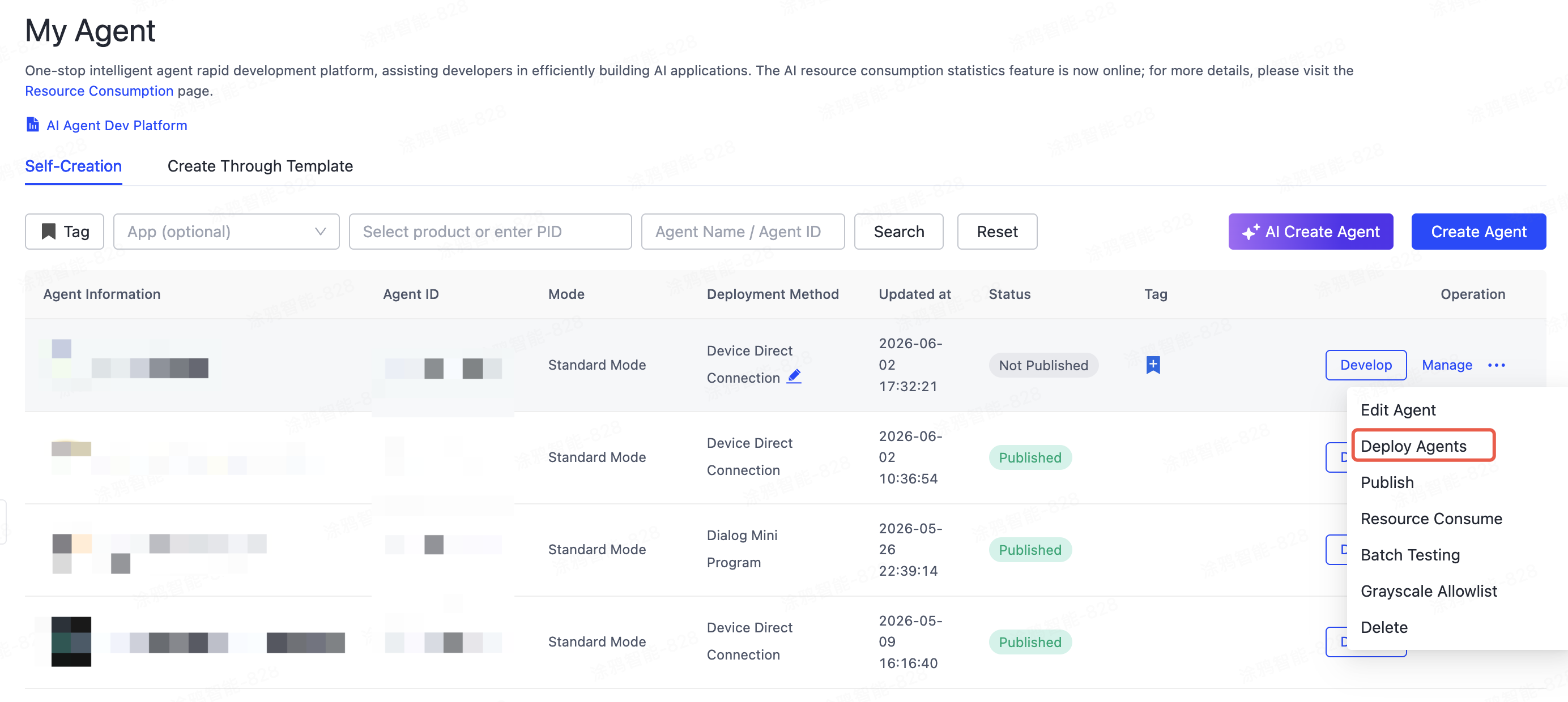
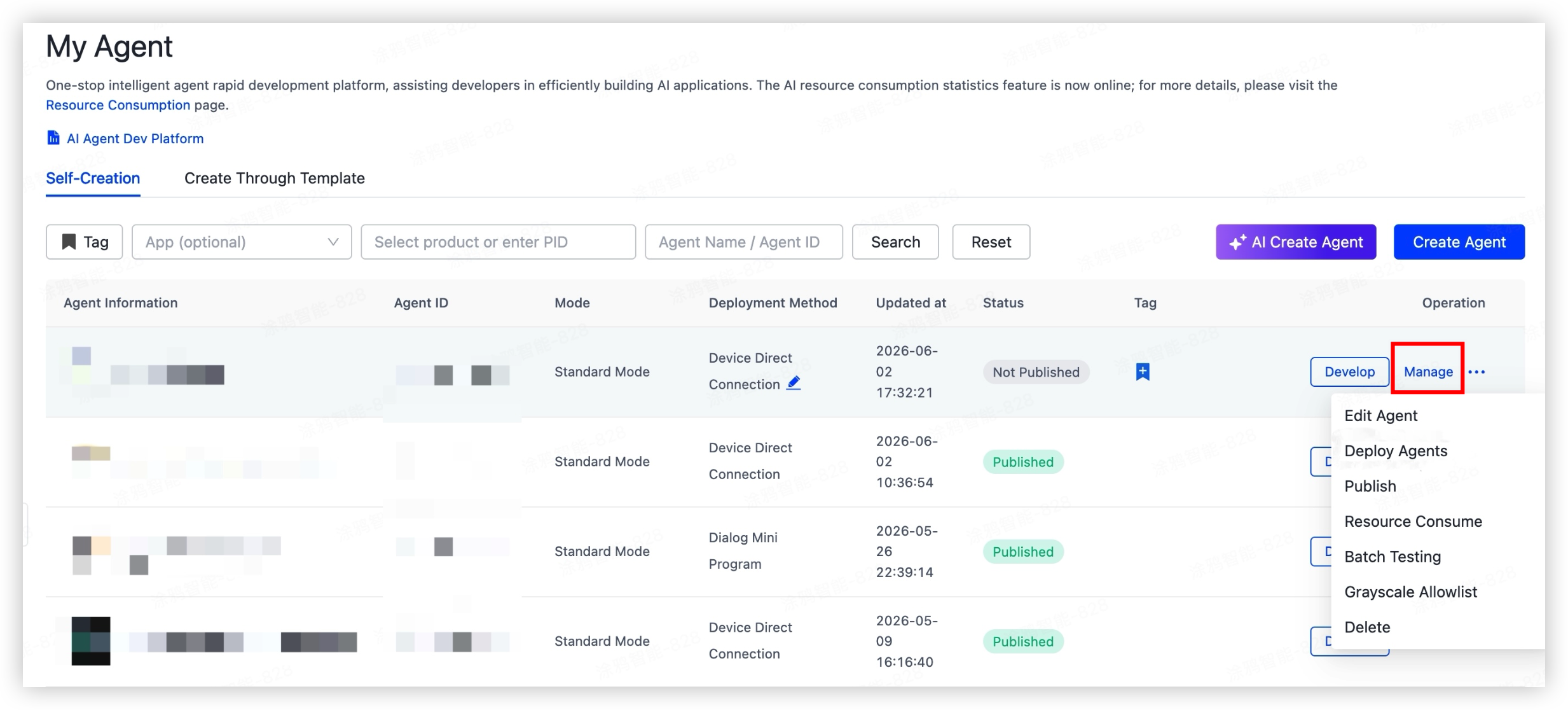
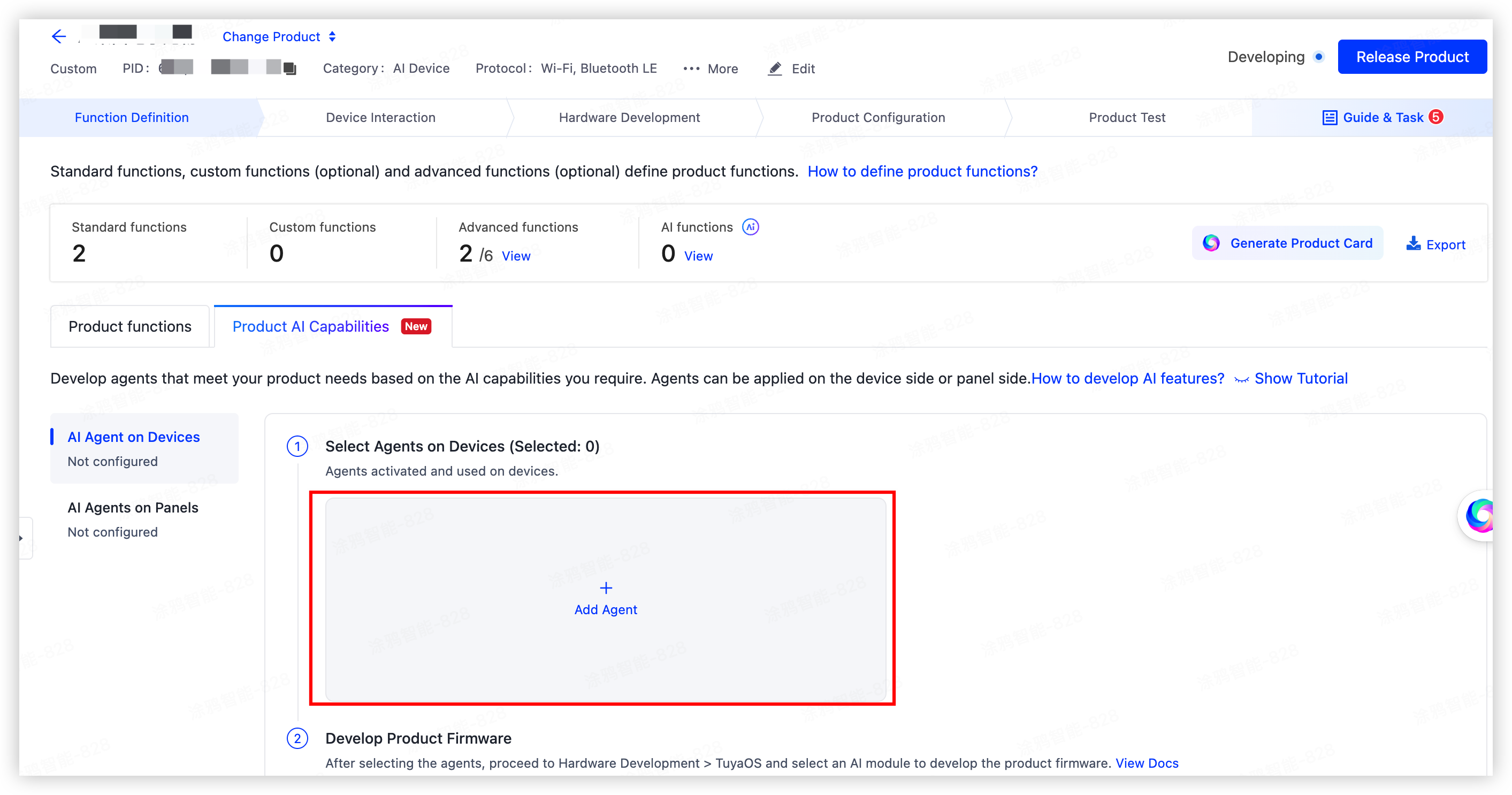
You can deploy AI agents from the My Agent list, the management page of an individual agent, or during AI feature development for a product, as shown below:
-
Method 1: Go to My Agent > More actions > Deploy Agents
-
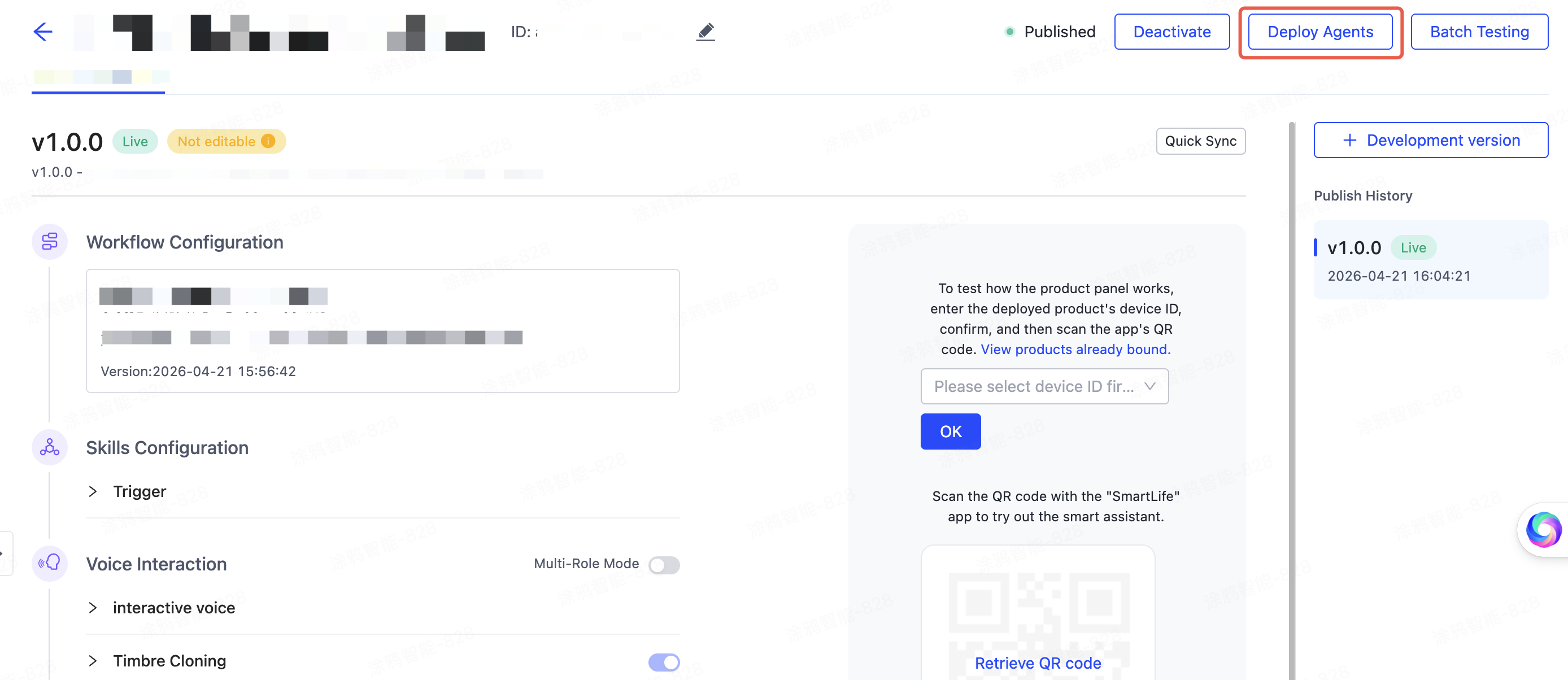
Method 2: Go to My Agent > Manage > Deploy Agents
-
Method 3: Go to Product Development > Function Definition > Product AI Capabilities, and you can quickly deploy an agent for a product.
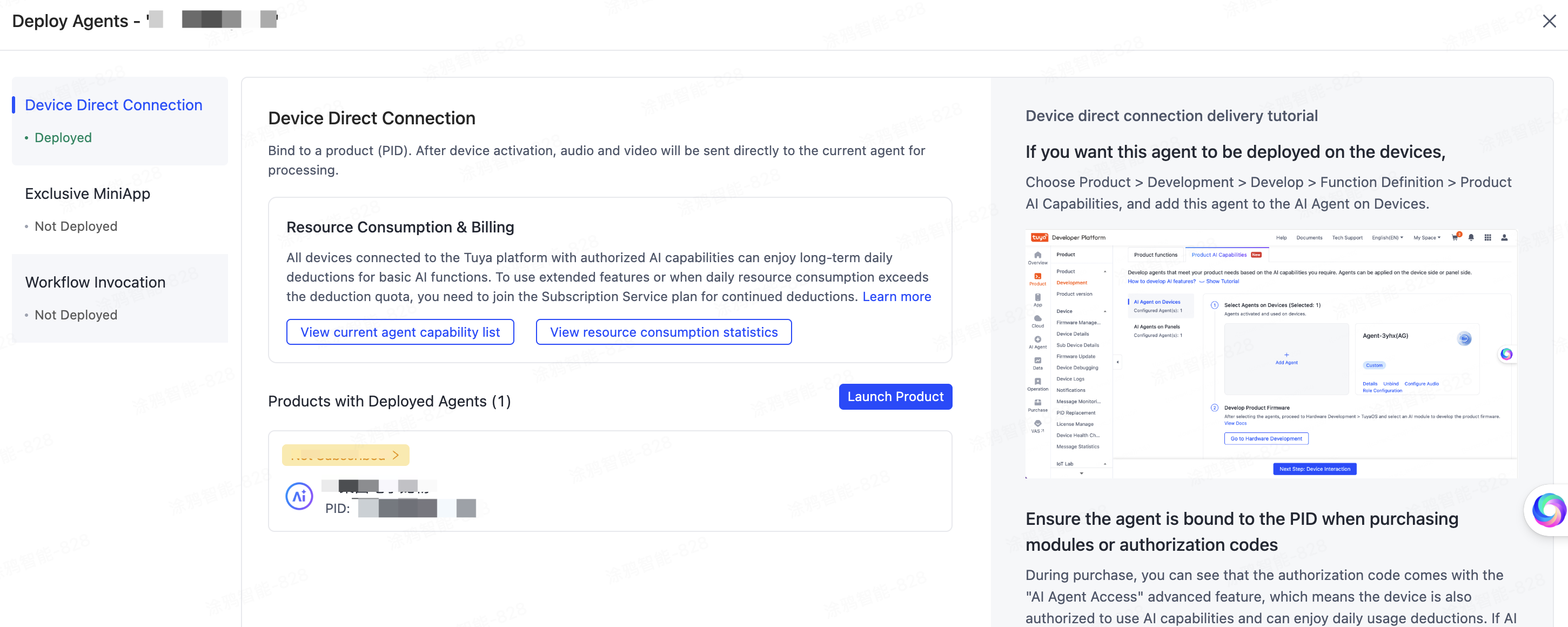
Deploy for direct device connection
Scenario
Bind a smart product to an agent. After you activate the authorized devices based on the product information, the devices automatically call the AI agent for interaction. This method is commonly used for product categories such as AI conversational interaction, device-initiated image recognition, and AI image generation.
Partnership model
Device access authorization
Devices directly connecting to AI must bind the agent to the product before purchasing modules or picking up licenses for the product. The generated licenses simultaneously provide authorization for AI agent access. When an activated device consumes AI basic resources (AI tokens), the system waives the consumption for devices with this authorization flag.
If the agent is not bound during module purchase or license issuance, meaning the license is generated without the AI agent access label, the system identifies the device as a standard device. If the device consumes AI tokens, it is not eligible for this waiver.
AI basic waiver
All devices with AI agent access authorization will have a certain amount of AI token consumption waived each day. Only the AI token consumption generated after the daily waiver quota is exhausted will be recorded as actual consumption.
Currently, during the AI device promotion partnership period, devices that meet the commercial partnership conditions will continue to have the remaining AI token consumption waived after the waiver quota is used up. Consult your commercial contact for details. When the promotion partnership period ends, Tuya will send a notification. Pay attention to the quotation of AI resources and other partnership information at that time.
AI extended capabilities
Based on your agent configuration, your product might require other AI extended capabilities such as online search, voice cloning, voiceprint recognition, and third-party music playback. Non-AI token consumption generated when devices use these services is not included in the scope of AI basic resource consumption. We recommend that you choose the following methods for further waivers.
Subscription model waiver
The AI extended capability subscription model is a platform feature that flexibly controls the daily AI usage of devices. It limits the daily free and paid energy caps for devices and provides a continuous recovery model. This enables users to use devices intermittently at any time without sustained high-frequency usage. This model meets the daily usage needs of most users and improves the user experience with flexible reminders of "take a break".
If you add the corresponding product to the subscription model, Tuya will provide unified subscription plans, benefit distribution, and usage statistics on the device side. Your product can receive additional waivers on top of the AI basic resource waiver, ultimately achieving a full waiver.
Tuya directly sells and fulfills this service in the Tuya All-in-one app. If you use an OEM app, you can choose to sign a distribution agreement with Tuya, or purchase a certain amount of services to sell and redeem independently.
-
If your product does not join the subscription model and the device does not meet other waiver policies, the system records normal resource consumption as actual consumption.
-
The current subscription model provides a unified basic plan. For additional partnership requirements, communicate with your commercial contact.
-
For details about all resource consumption generated in the device direct connection scenario, applicable waiver types, and daily waiver amounts, see Resource Consumption and corresponding guide documents.
Deploy as dedicated Miniapps
Scenario
Each agent automatically generates an independent basic conversational Miniapp, which does not currently support customization. The access path is provided on the deployment interface, allowing you to quickly access the Miniapp through a specified path in your own applications to implement AI agent interaction. This method is commonly used for embedding AI conversation pages in panels or apps.
Partnership model
Metering and billing based on usage: You can directly use the Miniapp after publishing the agent without additional authorization. Except for debugging scenarios such as QR code debugging and online debugging, the system uniformly records the AI resource consumption generated by real users as the actual consumption of the agent. Purchase credits to offset costs based on the actual usage statistics shown in Resource Consumption.
For additional partnership requirements, communicate with your commercial contact.
Deploy to workflows
Scenario
Deploy the agent to a specified workflow. When configuring the workflow, you can use the agent node to call the capabilities of the current agent.
Partnership model
This model is not an independent application deployment. Metering and billing policies are determined by the mode of the main agent associated with the workflow.
Is this page helpful?
YesFeedbackIs this page helpful?
YesFeedback