

Smart Ebike Development Guide
This topic describes how hardware, embedded, and app developers can develop Smart Ebike products on the Tuya Developer Platform.
Smart Ebike solutions are similar to smart electric motorcycle solutions. This topic follows the same eight-step workflow and describes the differences that are specific to Ebikes, including compact low-power hardware, signal shielding from aluminum or carbon fiber frames, European EN 15194 and North American UL 2849 certifications, data transmission-oriented with no analog control.
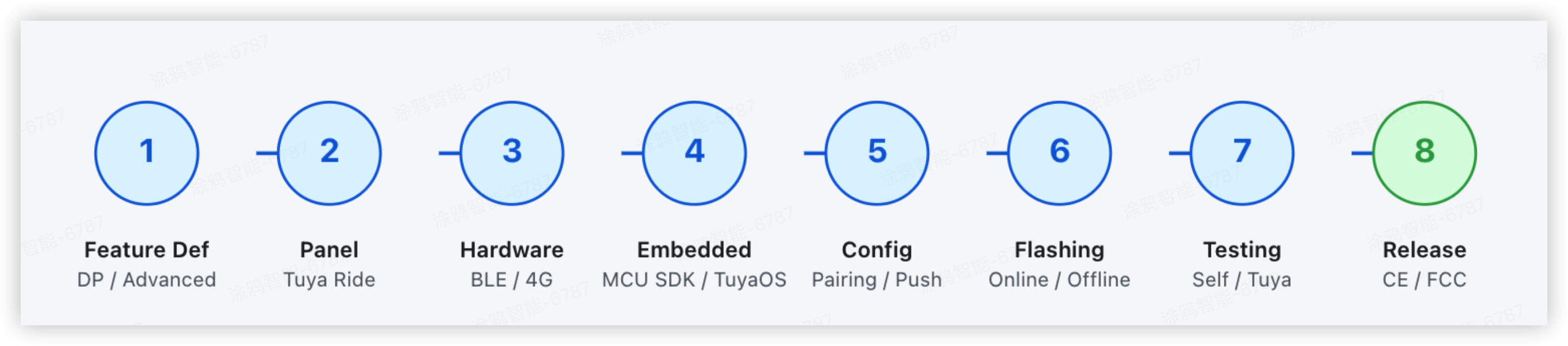
Before you start: confirm the Ebike product positioning
An Ebike, also called a pedal electric cycle (Pedelec), mainly targets Europe and North America. It is a bicycle with a pedal assist system (PAS), where the motor provides power as the rider pedals. Unlike electric bicycles that use full electric drive, an Ebike focuses on the combined mode of human power and electric assist.
| Dimension | Ebike (Pedelec) | Electric motorcycle |
|---|---|---|
| Drive mode | Pedal-triggered electric assist, based on a PAS or torque sensing | Full electric drive or throttle control |
| Maximum assisted speed | Europe: up to 25 km/h North America: Class 1 and Class 3 up to 32 km/h |
50 to 120+ km/h |
| Vehicle weight | 15 to 30 kg | 80 to 200+ kg |
| Frame material | Aluminum alloy or carbon fiber | Steel or aluminum alloy |
| Primary markets | Europe (60%+), North America (25%+) | Southeast Asia, mainland China, and South America |
| Certification | Europe: EN 15194 and CE marking North America: UL 2849 and Federal Communications Commission (FCC) certification |
China Compulsory Certification (CCC), E-mark, and Department of Transportation (DOT) certification |
| Smart positioning | Data transmission first, lightweight | Full-feature control and dashboard integration |
| Price range | €1,500 to €8,000+ | ¥8,000 to ¥50,000 |
Core principle for Ebike smart features: keep hardware compact and low-power, and focus on data transfer. Do almost no analog control. Unlike electric motorcycles, the smart module in an Ebike works as a vehicle data black box and remote connector, not as the vehicle control unit (VCU).
How the Ebike frame affects smart hardware
Both aluminum and carbon fiber frames shield wireless signals. This is the key constraint for smart Ebike design:
- Aluminum alloy frame: the metal tube greatly attenuates Bluetooth Low Energy (Bluetooth LE), 4G, and GPS signals.
- Carbon fiber frame: the carbon fiber weave shields high-frequency signals.
- Limited installation space: Ebikes do not have seat buckets or large trim parts like electric motorcycles. Smart hardware can only be embedded in the tube or integrated into the dashboard.
Design constraint: place antennas outside the frame or close to tube openings, and strictly control the size of smart hardware.
Create a product
Prerequisites
- You have registered an account on the Tuya Developer Platform.
- Verify your organization’s identity to unlock more features (recommended).
Procedure
Open the Tuya Developer Platform and click Create on the home page. Under Standard Category, select Outdoor Travel > Travel > Smart Electric Vehicle.
Ebike currently shares the same Smart Electric Vehicle category as electric motorcycles and electric bicycles. An incorrect category affects recommended DPs, panel selection, and app integration logic. Do not change the category after product creation unless you confirm the impact.
After you create the product, the platform generates a product ID (PID). Use this PID for all embedded, app, and cloud debugging.
Feature definition (DP)
Tuya abstracts hardware capabilities into Data Points (DPs). DPs fall into three categories:
| Type | Defined by | Application scenarios | Example |
|---|---|---|---|
| Standard features | Tuya platform | Common capabilities | Lock, unlock, battery level, speed, and positioning |
| Custom features | Developer | Standard features are not enough | Torque sensor data and custom assist levels |
| Advanced features | Platform-enabled | Cross-device and cloud services | QR code pairing, trip records, and password management |
DPs support only the following six data types: Boolean (Bool), Value, Enum, Fault/Bitmap, String, and Raw.
Common Ebike DPs (excerpt)
The following table reflects actual values from the Tuya standard DP templates for smart electric vehicles. It includes the minimum usable DP set for Ebike scenarios. Select the corresponding DP IDs during development.
| DP ID | Feature | Identifier (ID) | Type | Read/write | Description |
|---|---|---|---|---|---|
| 1 | Anti-theft switch | blelock_switch |
Bool | rw | Arm or disarm the Bluetooth anti-theft mode. |
| 3 | Battery level | battery_percentage |
Value | ro | Main battery level percentage, from 0 to 100. |
| 4 | GPS position | gps_position |
String | ro | Latitude and longitude string (available on 4G dashboard). |
| 5 | Speed | speed |
Value | ro | Unit: km/h. Range: 0 to 50. |
| 6 | Ride time | ridetime_once |
Value | ro | Unit: seconds. Accumulated duration of the current ride. |
| 11 | Unit setup | unit_set |
Enum | rw | km or mile, shown on the dashboard and the app. |
| 12 | Total mileage | mileage_total |
Value | ro | Unit: km. Accumulated mileage that persists after power-off. |
| 13 | Estimated range | endurance_mileage |
Value | ro | Estimated range based on the current battery level and assist level. |
| 14 | Current ride mileage | mileage_once |
Value | ro | Unit: km. Accumulated mileage of the current ride. |
| 18 | Assist level | level |
Enum | rw | eco, tour, sport, turbo. An Ebike usually supports three to five levels. |
| 19 | Find vehicle | search |
Bool | rw | Trigger a beep from the app to locate the vehicle. |
| 27 | Status | status |
Enum | ro | Vehicle status, such as standby, riding, charging, and fault. |
| 29 | Power system | power_system |
Fault | ro | Fault Bitmap for the motor, controller, sensor and more. |
| 30 | Smart system | smart_system |
Fault | ro | Fault Bitmap for the central control, communication, positioning, and more. |
| 32 | Battery system | lithium_battery_system |
Fault | ro | Fault Bitmap for the battery and BMS. |
| 45 | Geofence | geofence_switch |
Bool | rw | Geofence switch (available on the 4G form). |
| 58 | Battery information | battery_info |
String | ro | Detailed battery fields, such as voltage, temperature, and cycle count. |
| — | Cadence | cadence |
Value | ro | Custom DP. Unit: revolutions per minute (RPM). Cadence sensor data. |
| — | Human power | human_power |
Value | ro | Custom DP. Unit: W. Calculated from torque sensor data. |
| — | Motor power | motor_power |
Value | ro | Custom DP. Unit: W. Real-time motor output power. |
Differences from electric motorcycles
Ebike solutions add riding data DPs, such as cadence, human_power, and motor_power. Ebike DPs mainly report read-only data. Ebikes support only a few writable control DPs, such as the anti-theft switch, assist level, and find vehicle.
Fault DP design
An Ebike splits faults into three Fault DPs by subsystem. Within each DP, each bit represents one type of fault source.
power_system                  smart_system           lithium_battery_system
bit0  Motor overheat          bit0  BLE comm loss      bit0  Low battery
bit1  Motor Hall fault        bit1  4G comm loss       bit1  Battery overheat
bit2  Controller overheat     bit2  GPS fix lost       bit2  Battery under-voltage
bit3  Torque sensor fault     bit3  OTA interrupted    bit3  Battery over-voltage
bit4  Speed sensor fault      bit4  Cloud auth fail    bit4  Cell voltage delta
bit5  Cadence sensor fault    ...                      bit5  BMS comms fault
...                                                    ...
When to use custom DPs
Add a custom DP when the standard DP table does not cover a capability you need. For example:
- Use a RAW DP and define your own byte protocol for raw cell voltages from a custom BMS.
- Use a Bool DP named
climb_mode_enablefor a brand-specific climb mode switch. - Use Value DPs for riding data, such as cadence, torque, and power.
Advanced features (enable as needed)
The following features are often used on Ebikes:
- QR code pairing: users scan the QR code on the vehicle with the app to bind the device.
- Trip records: the cloud stores ride routes, and the app replays them.
- Password management: users can unlock the vehicle with a local four-to-six-digit password.
- Bluetooth keepalive: the vehicle unlocks when the phone is close and locks when the phone moves away.
- Direct-to-cloud connection: a 4G version connects to the cloud directly without a phone.
- Geofence: anti-theft alerts (available on the 4G form).
Configure the panel
Select a ride app
Smart electric vehicles and Ebikes must use Tuya’s dedicated ride apps, not the SmartLife app. Select the app by sales region:
| Sales territory | Control app | App store keywords |
|---|---|---|
| Mainland China | 涂鸦出行 | 涂鸦出行 |
| Overseas (Europe and North America) | Tuya Ride | Tuya Ride |
The platform might prompt you to scan the QR code with the SmartLife app for testing. This prompt does not apply to the smart electric vehicle category. Download 涂鸦出行 or Tuya Ride by sales region to preview and test the panel.
Electric vehicle all-in-one panel
涂鸦出行 or Tuya Ride includes an electric vehicle public panel. Most Ebike customers can use it out of the box without customization.
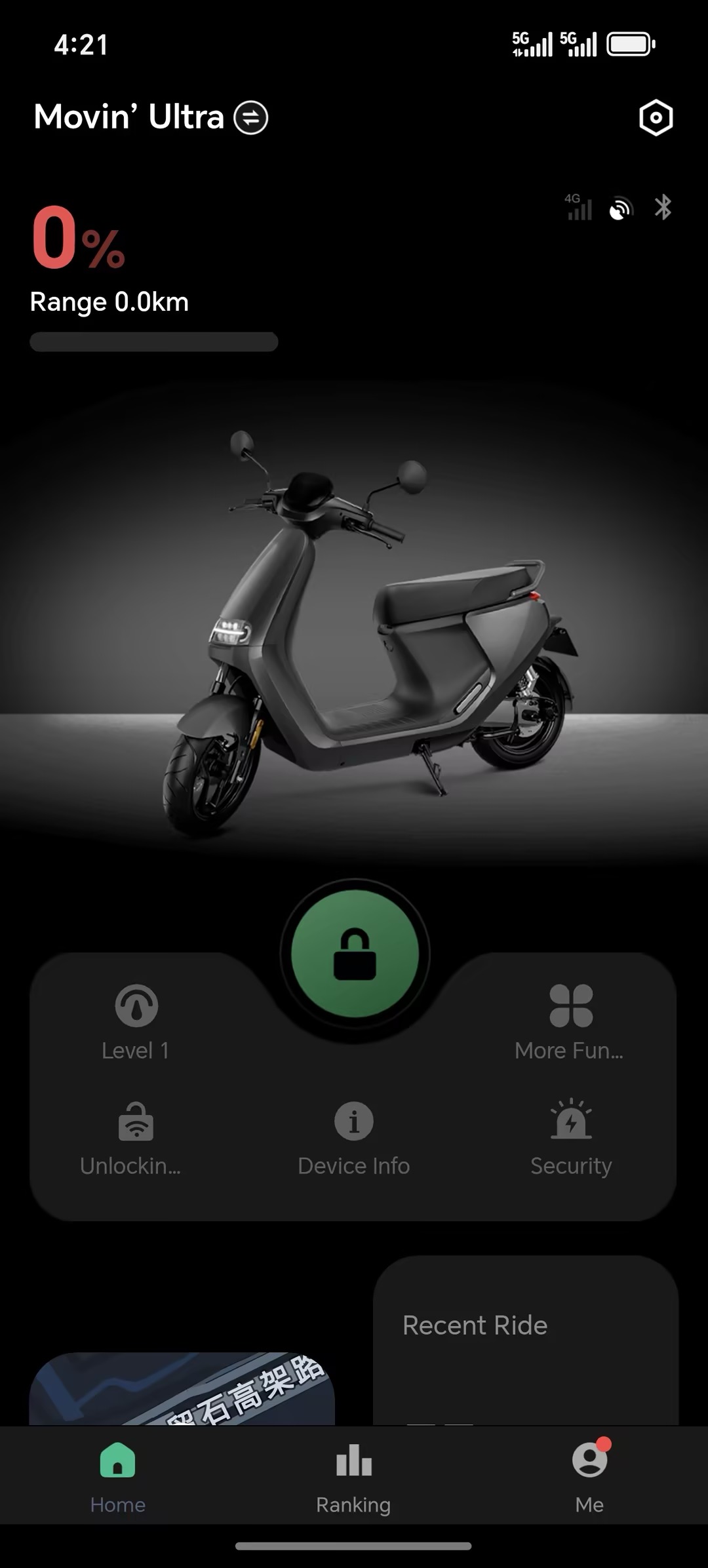
The all-in-one panel covers the following capabilities:
- Home: vehicle status card, including battery level, range, assist level, and communication signal.
- Control: one-tap lock and unlock, assist level switching, and find vehicle.
- Settings: unlock methods, speed limit, anti-theft sensitivity, and password management.
- Services: inspection report, route playback, and geofence.
Apply for a custom panel only when you need strong differentiation, such as a custom BMS details page, brand-specific 3D model, or brand theme color.
Role split between phone and dashboard
Ebike smart interactions differ from electric motorcycle interactions. Ebikes ride at a relatively low speed, usually up to 25 to 32 km/h. Users can check the phone when parked, but the dashboard remains the primary information entry while riding.
- Dashboard (while riding): battery, speed, assist level, mileage, fault alerts.
- Mobile app (not riding): remote vehicle search, remote locking, riding data analysis, trip replay, over-the-air (OTA) updates, and parameter settings.
Ebike scenario characteristics: compared with an electric motorcycle, the Ebike dashboard is more streamlined (usually a segment LCD or a small TFT), so the mobile app takes on more data dashboard and configuration tasks.
Design hardware
Tuya offers two hardware integration paths for Ebikes. Choose one based on the compute capacity of your main controller and your cost target:
| Solution | Microcontroller | Module | Best for | Difficulty |
|---|---|---|---|---|
| MCU SDK | Your MCU | Tuya Bluetooth or 4G module | The mainstream option, used most often | Low |
| TuyaOS | Module runs the business logic | TuyaOS-compatible module | Sufficient resources and cross-platform goals | Medium |
Select a communication protocol
| Scenario | Recommendation |
|---|---|
| Standard Ebike, user mainly views data on the phone | Bluetooth LE (preferred) |
| Shared bicycles or rental fleets | Bluetooth + 4G dual mode |
| High-end Ebike that requires anti-theft tracking | Bluetooth + 4G dual mode |
Bluetooth serves as the primary communication protocol for Ebikes for the following reasons:
- It consumes minimal power, ensuring no impact on battery life.
- It does not require SIM cards or data plans, which removes overseas operating costs.
- It supports passive unlock when you enable Tuya’s advanced Bluetooth keepalive capability.
Select a hardware form factor
By feature granularity and cost, Ebike smart features come in three typical form factors. All three form factors use the BLE + X hardware architecture:
| Form factor | Communication capabilities | Typical features | Advantages | Disadvantages | Recommendation |
|---|---|---|---|---|---|
| Bluetooth dashboard | Bluetooth LE only | Riding data display, Bluetooth OTA, riding data collection, and Bluetooth anti-theft. | Quick development, simple and mature hardware, and no SIM card or data. Bluetooth can integrate into small dashboards. | No remote capability, only short-range access. | Recommendation |
| 4G smart T-box | Bluetooth LE, 4G, and GPS | Remote location, remote vehicle data view, and remote operations. | Supports remote operations and location through 4G, Bluetooth LE, and GPS. | Aluminum or carbon fiber frames shield signals. The T-box usually fits only inside a frame tube, which weakens signals. | Standard |
| 4G dashboard | Integrated Bluetooth LE, 4G, and GPS | Dashboard display and all remote capabilities (the most integrated option) | Integrates 4G, Bluetooth LE, and GPS into the dashboard. It does not add vehicle parts and provides much better antenna signals than a T-box. | The dashboard volume and cost increase slightly. | Recommendation |
Selection recommendation:
- Most Ebikes use a Bluetooth dashboard: this form factor supports fast development. The hardware uses only Bluetooth, which makes it simple and mature. It does not involve SIM card data traffic. A compact dashboard can still integrate Bluetooth features, support Bluetooth OTA updates, and collect riding data.
- Need remote capability: 4G dashboard. Integrates 4G, Bluetooth, and GPS into the dashboard, adding no extra parts to the vehicle. The system is simple and highly integrated. The antenna signal is much better than that of a T-box.
- 4G T-box is not the first choice. Both aluminum and carbon fiber Ebike frames shield the signal. An Ebike has no room for a 4G T-box and usually has to embed it in a tube, where the signal is relatively poor.
BLE + X hardware architecture
The BLE+X architecture uses Bluetooth LE as the system hub. The module connects to the vehicle MCU and the 4G Category 1 (Cat. 1) module through Universal Asynchronous Receiver/Transmitter (UART), when the product needs 4G. Bluetooth LE handles short-range control, low-power keep-alive, and power management. The 4G module provides remote capabilities. The MCU handles vehicle service logic. Tuya recommends that you connect an independent GPS module directly to the MCU through UART. The MCU parses National Marine Electronics Association (NMEA) data and reports results as needed.
Key difference for Ebikes: smart hardware must be compact and low-power. It should mainly provide data transfer and almost no analog control.
Bluetooth dashboard architecture (recommended)
            ┌──────────────┐
            │ BLE module   │── 📱 Direct BLE ── Tuya Ride app
            │ (BF6H-M)     │
            │ System hub   │
            │  + Dashboard │
            └───────┬──────┘
                   │ UART
                   │
            ┌──────┴─────────────┐
            │    MCU             │
            │  Vehicle controller│
            │ (PAS system)       │
            └────────────────────┘
The Bluetooth dashboard form is the simplest. The Bluetooth LE module is integrated on the dashboard PCB. It communicates with the vehicle controller over UART, obtains riding data (speed, cadence, battery level, mileage, and so on), and syncs the data to the app over Bluetooth LE. It supports Bluetooth OTA upgrades for the dashboard firmware.
4G dashboard architecture (recommended)
                           ┌─────────────────┐
                  ┌──UART──┤ 4G CAT.1 module │── ✈ Cloud
                  │        └─────────────────┘
            ┌─────┴─────────────┐
            │ BLE module        │── 📱 Direct BLE ── Tuya Ride app
            │ (BF6H-M)          │
            │ System hub        │
            │ + Power management│
            └─────┬─────────────┘
                  │ UART
                  │
            ┌─────┴─────────────┐         ┌──────────────────────┐
            │   MCU             │── UART──┤ Standalone GPS module│── Satellite
            │ Vehicle controller│         │ GB600/610 and more   │
            └───────────────────┘         └──────────────────────┘
The 4G dashboard integrates all communication modules (Bluetooth LE + 4G + GPS) on the dashboard PCB. The antennas are exposed on the dashboard housing to avoid shielding by the frame metal or carbon fiber.
Key pins of the Bluetooth module (BF6H-M)
| Pin (silk screen) | I/O | Direction | Feature |
|---|---|---|---|
TXD0 / RXD0 |
PD7 to PD6 | OUT / IN | UART communication with the 4G module (used in the 4G dashboard form) |
TXD1 / RXD1 |
PA3 to PA2 | OUT / IN | UART with MCU. |
PWM1 |
PA7 | IN | Cellular module wakes up Bluetooth (low level ≥ 60 ms) |
PWM0 |
PA6 | IN | Cellular presence detect (active low) |
PWM5 |
PA5 | OUT | Bluetooth controls 4G power (active high to power on) |
PA1 |
PA1 | OUT | Bluetooth wakes up the MCU (drive high ≥ 20 ms before sending data) |
PA0 |
PA0 | IN | MCU wakes up Bluetooth (drive high ≥ 50 ms before sending data) |
Key handshake timing
- Cellular module wakes Bluetooth: before sending UART data, the 4G module outputs a low level on PWM1 for at least 60 ms to make sure Bluetooth LE exits sleep.
- Bluetooth wakes MCU: pull up PA1 for at least 20 ms before sending UART data. The MCU wakes through an I/O interrupt.
- MCU wakes Bluetooth: pull up PA0 for at least 50 ms before sending UART data to prevent byte loss.
- Return to low after data transmission: after data transfer ends, pull the wake line low to enter low-power state.
Level matching
The UART between the Bluetooth module at 3.3 V and the 4G module at 1.8 V must use level shifting to prevent port damage and unstable communication. Tuya recommends two solutions:
| Solution | Component | Strength | Best for |
|---|---|---|---|
| Bidirectional level translator | TXS010X or SN74LVC series | Few components, strong anti-interference capability, and automatic bidirectional translation | Mass production |
| Discrete NPN inverter | S8050 with 10 KΩ and 1 KΩ pull-up resistors | Lowest cost | Minimal or low-cost design |
Standalone GPS module integration (4G dashboard form)
Connect the standalone GPS module to the vehicle MCU through UART. The MCU parses NMEA messages and reports location, speed, satellite count, and other results as DPs.
| Recommended GPS module | Manufacturer | Frequency bands | Application scenarios |
|---|---|---|---|
GB600 |
Tuya | L1 single frequency, five-system multimode: GPS, BDS, Galileo, QZSS, and GLONASS | Preferred for entry-level and low-cost mass production. Uses the Beken BK1661 SoC and offers a compact and low-power design. |
GB610 |
Tuya | L1 + L5 dual-band (multi-mode and multi-band joint positioning) | High-precision scenarios. Beken BK1662 SoC and 120 tracking channels. |
Wiring notes:
- MCU UART to GPS UART: default baud rate 9,600 or 115,200. Connect RX and TX.
- Power supply: GPS modules usually use a 3.3 V power supply. The MCU controls the switch through a GPIO or an LDO enable pin, and powers off the GPS during sleep.
- Antenna: aluminum and carbon fiber Ebike frames cause severe shielding. Place the GPS antenna outside the top of the dashboard housing or at the top of the handlebar stem, away from metal shields.
- Level: the MCU and GPS module usually use 3.3 V, so no level shifting is required.
Tuya recommended modules
Tuya has verified the following modules in mobility scenarios. You can search all datasheets and SDK documents in the Tuya Developer Platform.
Bluetooth module
| Model | Sales territory | Frequency bands | Size | Resource link |
|---|---|---|---|---|
BF6H-M |
Global | 2.4 GHz ISM band | 19×15.5×2.5 mm |
4G modules (choose by sales region, used in the 4G dashboard form)
| Model | Sales territory | Frequency bands | Size | Resource link |
|---|---|---|---|---|
L511E-Y6E |
Europe, Southeast Asia, Africa, Australia, Middle East, Hong Kong, Macau, and Taiwan | LTE FDD B1/3/5/7/8/20/28, TDD B38/40/41 | 17.7×15.8×2.3 mm | |
L511A |
North America | LTE FDD B2/4/5/12/13/14*/66/71 | Same as above | Same as the L511 series |
Selection rule: use BF6H-M for Bluetooth. It supports global deployment. Select the 4G module by target market. Use L511E-Y6E for Europe and L511A for North America. Most Ebike export scenarios target Europe and North America, and these two modules cover most requirements.
Embedded development
MCU SDK path (recommended)
Workflow:
Your MCU                    Tuya Bluetooth module              Phone app / Cloud
┌─────────────────────┐ UART  ┌───────────────────────┐ BLE/4G  ┌──────────────┐
│  Vehicle controller │<----->│ Tuya standard protocol│<------> │ Tuya Ride    │
│  + MCU SDK          │ TX/RX │(Universal)            │         │  + Tuya cloud│
└─────────────────────┘       └───────────────────────┘         └──────────────┘
The MCU SDK helps you implement:
- Frame encapsulation and parsing. You only handle DP sending and receiving, not serial bytes.
- Heartbeat, state machine, and reconnection.
- OTA reception and verification.
- Time synchronization and pairing state machine.
Implement only the following two callbacks:
dp_download_handle(): handle control DPs sent from the app, such as assist level switching.dp_report(): report current status DPs, such as speed, battery level, and cadence.
TuyaOS path
The module itself runs the TuyaOS kernel, and the vehicle MCU integrates through a simple interface. The benefit is that one set of business code can be reused across chip platforms and protocols (Bluetooth or cellular).
Use TuyaOS when:
- One vehicle model needs both a Bluetooth version and a Bluetooth + 4G version.
- The vehicle MCU is short on resources, and you want the module to run the business logic.
- You want to use TuyaOS components directly, such as OTA, KV storage, and RPC.
Embedded development rules
- DP reporting frequency: report high-frequency DPs, such as speed and cadence, at 1 Hz or higher. Report low-frequency DPs, such as battery level and mileage, only when values change. Avoid unnecessary data traffic.
- OTA chunks: support resumable transfer for Bluetooth OTA. For major 4G OTA versions, push updates when the device is charging.
- Fault reporting: report faults with Fault DPs and Bitmaps. Do not create a separate Bool DP for each fault.
- Power loss protection: write cumulative values, such as mileage and ride records, to flash memory so power loss does not erase them.
- Low-power design: keep Ebike standby current at 50 μA or less for the entire smart module to prevent battery drain during long-term parking.
- European compliance: report the assist cut-off state at the 25 km/h speed limit through a DP to support traceability.
Configure the product
Go to Product Configuration on the Tuya Developer Platform. Select and configure the following items as needed:
| Item | Ebike focus |
|---|---|
| Firmware update | Support Bluetooth OTA. Add cellular OTA for 4G versions. |
| Multilingual support | Required: Chinese and English |
| Pairing information | Select Bluetooth LE for pairing. |
| Device information push | Send anti-theft alerts, low battery alerts, and geofence breach alerts through push channels. |
| Scene linkage | Rarely used on Ebikes. You can leave it disabled at first. |
| Shortcut switches | Add one-tap lock and find vehicle to the app homepage. |
| Product manual | Use the electronic manual on the platform. |
Pairing example (Bluetooth)
Ebikes do not use Wi-Fi, so the only pairing channel is Bluetooth. Tuya recommends the following two Bluetooth LE pairing methods:
| Solution | Trigger method | User operation | Application scenarios |
|---|---|---|---|
| A: Bluetooth-triggered pairing | The user presses and holds the dashboard button for 5 seconds to enter broadcast state. | The app discovers the device automatically through Add Device. | Entry-level Ebikes |
| B: Bluetooth QR code pairing | A unique QR code (with PID, MAC, and token) is pre-printed on the vehicle. | Tap Scan in the app to bind. | Mid-range and high-end Ebikes that focus on out-of-box experience. |
Solution comparison
| Dimension | A: Triggered pairing | B: QR code pairing |
|---|---|---|
| User experience | Average: users must learn the trigger action. | Smooth. Scan to bind. |
| Mispairing prevention | Weak: nearby vehicles broadcast under the same name. | Strong: the QR code locks the target device. |
| Production process | Simple: no dedicated code needed. | Complex: generate and print the QR code. |
| Recommended group | Entry-level or Bluetooth dashboard form | 4G dashboard or high-end vehicle |
Recommendation: for high-end complete vehicle shipments, use solution B first. Keep solution A as a fallback.
Push examples
| Trigger | Push content |
|---|---|
| Unusual movement detected when the vehicle is stationary | "Your bike detected unusual movement." |
| Battery at or below 15% | "Low battery — please charge soon." |
| Outside the geofence | "Your bike has left the safe zone." |
| OTA complete | "Firmware updated successfully." |
Flash the firmware and authorize the module
Flash the firmware and the license to the device, or the device cannot connect to the cloud.
For the complete solution, flashing tool downloads, pin wiring for different modules, and production test processes, see Flashing and Authorization.
Three official Tuya solutions
| Official solution | Best for | Description |
|---|---|---|
| Flashing and authorization combined | Tuya standard module |
|
| Flashing and authorization separated | Debug stage or non-Tuya standard modules | Authorize only. Flash the firmware with the chip vendor’s tool. |
| Production test integration | A complete in-house production system | Connect to your production line through the Tuya standard interface and run flashing and authorization in-house. |
For solution selection and the production test interface specification, see Flashing and Authorization.
Practical options for Ebike production
| Option | Best for | Official solution | Description |
|---|---|---|---|
| Online flashing | Sample stage | Flashing and authorization combined | Device connects directly to Tuya cloud for authorization. |
| Offline flashing | Factory mass production | Flashing and authorization combined | Send the authorization package in advance. |
| End-of-line authorization | One-time write during end-of-line vehicle testing | Separate flashing and authorization, or production test integration | Recommended. Merge into the end-of-line station workflow. |
| MCU self-flashing | MCU runs the authorization process | Production test integration | MCU SDK solution only. |
Production recommendations
- Use one license per PID. Do not reuse codes.
- Add power-on and power-off test + Bluetooth connection test to the end-of-line test items to prevent missed flashing.
- Different modules use different flashing pins, writers, and drivers. See the corresponding sections in Flashing and Authorization.
Test the product
Before release, prepare a test report through one of the following methods:
- Self-test: download test cases from Testing Service, run the tests, and upload the report.
- Tuya Cloud Test app: run test cases directly with the cloud test app.
- Tuya test service: pay the Tuya test team to run tests for you.
Additional focus items for Ebike testing:
- Bluetooth signal coverage inside aluminum or carbon fiber frames, with stable connection at 5 m or more recommended.
- Bluetooth LE connection stability under riding vibration.
- Battery DP reporting accuracy at extreme temperatures from -10°C to 45°C.
- Recovery after power-off during OTA, including resumable transfer.
- Measured low-power standby current, with 50 μA or less for the whole module.
- Consistency of assist cut-off at the EN 15194 speed limit.
Release and certify the product
Release
After the test report passes, release the product on the Tuya Developer Platform. After release, use the PID for mass production authorization.
Required certifications
Ebikes mainly target Europe and North America. The certification requirements are as follows.
| Target | Europe | North America |
|---|---|---|
| Vehicle | EN 15194:2017+A1:2023 (Pedelec safety and performance) + CE marking | UL 2849 (electric bicycle electrical system safety) |
| Bluetooth module | CE-RED (Radio Equipment Directive 2014/53/EU) | FCC Part 15 |
| 4G module | CE-RED | FCC Part 22/24/27 |
| Battery | EN 62133-2 (lithium battery safety) + UN38.3 (transport) | UL 2271 (light electric vehicle battery) + UN38.3 |
| Charger | EN 60335-2-29 + CE | UL 1310/UL 60950 |
| EMC | EN 301 489 (wireless EMC) | FCC Part 15B |
Certification description:
- EN 15194:2017+A1:2023: mandatory European standard for Pedelec. It covers mechanical safety, electrical safety, assist performance, charging system safety, and other requirements. The 2023 amendment adds battery system safety and functional safety requirements.
- UL 2849: the North American electrical system safety standard for electric bicycles. It covers safety assessment of the battery, motor, controller, charger, and wiring.
- CE marking: the mandatory marking for EU market access. For Ebike, it covers the Machinery Directive (2006/42/EC), EMC Directive (2014/30/EU), and RED (when wireless modules are present).
- FCC: all devices with wireless communication must pass FCC certification for the North American market.
Pre-release checklist
- EN 15194 and UL 2849 complete vehicle certifications passed.
- CE and FCC wireless module certifications obtained.
- Battery certifications completed, including EN 62133, UL 2271, and UN38.3.
- Multilingual settings configured, with at least English and the target market’s local language.
- Bluetooth OTA resumable transfer verified.
- Low-power standby current of 50 μA or less measured.
- Release region matched with 4G frequency bands, when applicable.
Appendix: Ebike and electric motorcycle solution differences
| Dimension | Smart Ebike | Smart electric motorcycle |
|---|---|---|
| Drive mode | PAS | Full electric drive |
| Speed range | ≤ 25 to 32 km/h | 50 to 120+ km/h |
| Primary markets | Europe and North America | Southeast Asia, mainland China, and South America |
| Frame material | Aluminum alloy or carbon fiber, with signal shielding | Steel or aluminum alloy |
| Smart hardware positioning | Mainly data transfer, no analog control | Full-feature control and dashboard integration |
| Recommended hardware form factor | Bluetooth dashboard (preferred) or 4G dashboard | Bluetooth anti-theft device, 4G central controller, or 4G dashboard |
| Power consumption requirement | Very low (50 μA or lower standby) | Low (200 μA or lower standby) |
| Dashboard type | Segment LCD or small TFT | TFT color screen with rich features |
| Pairing protocol | Mainly Bluetooth LE | Mainly Bluetooth LE, with optional 4G |
| Certification | EN 15194 + CE/UL 2849 + FCC | China Compulsory Certification (CCC), E-mark, and Department of Transportation (DOT) certification |
| Typical DP count | 20 to 40 | 50 to 100 |
| Price range | €1,500 to €8,000+ | ¥8,000 to ¥50,000 |
| Language | Mainly English, German, French, Dutch, and Italian | Mainly Chinese, with multilingual support for overseas markets |
FAQ
Should Ebikes and electric motorcycles use the same PID or separate PIDs?
We recommend that you create separate PIDs. Ebikes and electric motorcycles differ significantly in DP sets, panel layout, and certification, so sharing a PID causes feature redundancy and maintenance difficulty.
How do I choose between the Bluetooth dashboard and the 4G dashboard?
Use the Bluetooth dashboard for most Ebikes. It supports fast development, uses simple and mature hardware, and avoids SIM card operating costs. Use the 4G dashboard when your product requires remote anti-theft tracking, fleet management, or similar capabilities. The 4G dashboard integrates 4G, Bluetooth LE, and GPS into the dashboard, and its signal quality is much better than a T-box.
How do I solve signal shielding from aluminum or carbon fiber frames?
- Expose the antenna on the dashboard housing or at the top of the handlebar stem.
- Avoid wrapping the module entirely inside a metal tube.
- If you must embed the module in a tube, open a hole in the tube wall or use a non-metallic cover for RF transparency.
- The 4G dashboard form factor outperforms the T-box form factor because the dashboard antenna location is better.
Which app fits overseas vehicles?
Use Tuya Ride for overseas sales. Use 涂鸦出行 for the Chinese mainland. Both apps provide the same panel capabilities. Select the app by sales region.
Development focus: multi-language (German, French, Dutch, Italian, Spanish), regional compliance (GDPR), and Bluetooth LE pairing first.
What special considerations apply to Ebike OTA?
The Bluetooth dashboard form can only use Bluetooth LE OTA, which has a relatively low transfer rate (about 4 to 8 KB/s). We recommend that you keep the firmware package under 200 KB and support resumable transfer. The 4G dashboard form can use cellular OTA for major version updates, which we recommend you push during charging.
Is this page helpful?
YesFeedbackIs this page helpful?
YesFeedback